Monday, 20 June 2022

The use of interleaving to enhance pupils progress in science - Iram Fazal

The use of effective learning techniques is required in classrooms to improve the educational outcome of pupils. There are various techniques already deployed to enhance pupils learning. Interleaving is one technique that has been shown to considerably enhance long-term memory, the retention of information, leading to improved academic outcome for students. As the name suggests, it involves that mixing of different topics or practice to aid learning. It is believed that interleaving works by leveraging several cognitive mechanisms used by the brain in forming long-term memory.

According to Abbott, “college pupils who did ‘practice tests’ acquired higher grades in their exams” (Abbott, 1909). The correct retrieval of an answer from memory can have a direct effect on the memory, i.e. “Enhances retention by triggering elaborate retrieval processes” (Carpenter 2009: 768)   Moreover, a failure to answer correctly indicates that a pupil needs to practice the answers (Dunlosky, 2013: 3).  Roedger and Butler state that “The retrieval of information from memory through practice tests produces better retention than restudying the same information for an equivalent amount of time and has been termed the ‘testing effect’” (Roediger and Butler, 2011: 20). Walters & Kandel showed that long-term memories are formed through the repeated stimulus of an existing pathway in the brain causing additional connections between brain cells by newly formed proteins (Walters & Kandel, 1982). 

In contrast to the current practice of “blocking” adopted by schools, where a single topic or skill is practised at a time before moving on to the next (Dunlosky et al 2013: 40, Tylor & Rohrer, 2010).  In my research, the interleaving technique was used, which is based on Eric Kandel’s discoveries from experiments on the neurons of Sea Slugs, and has yielded impressive results. The technique involves mixing or “interleaving” practice sessions covering a number of topics or skills.  “Interleaving ensures that practise of any particular skill is distributed or spaced and is not consecutive” (Taylor and Rohrer, 2010).   Instead of practice topics following the format “aabbccdd”, a mixed practice format such as “abcdcadbdcba” is followed, e.g., mixed up homework questions on “Food and nutrition”, “Combustion” and “Metals and their uses”. The way long-term memory forms and the success of interleaving have important implications for teaching; research suggests pupils will retain more of what they learn in their long-term memory, improving their success in examinations.

Who knew research into sea slugs would translate into classroom practice!?

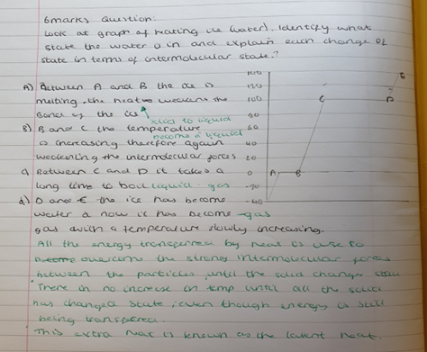
In my study, I introduced interleaved practice quizzes and 6 mark questions with a high ability year 8 group. The study was carried out in the spring term over 6 weeks, one lesson per week for quizzes from the previous topics.

Another study was completed in the summer term over 6 weeks, one lesson per week for 6-mark questions from the previous topics.  While pupils are of high ability with good knowledge of the topics being taught, they tend to score low marks in 6-mark questions at the end of unit tests and exams. 

At the end of both trials, the data was collected; a survey was carried out to evaluate the study and techniques used in this experiment. 

6 mark question sample

The results showed that interleaving practice had a positive effect on pupils’ learning (as prevous research has suggestd). Student scores showed an improvement in recall and the survey and interviews with puplis showed that 97% of pupils thought the interleaving technique was effective and allowed them to revise topics and remember more information by the time they sat their end of year exams. 77% of the pupils supported using interleaving as an effective technique for revision in the classroom. 

Further Research

  • The scope of this study was a limiting factor in the evaluation of the results. The time constraint of 12 weeks was short for a study of long-term memory and the sample group was small in size. 
  • A further difficulty was pupils’ unwillingness to do practice tests within the required time frame which was integral to the study.  Limited time also meant the resource could only be tried on one group of high ability. 

Recommendations

It is clear that interleaving can have an impact on the longer term memory and recall of students. Interleaving, coupled with retrieval practice, should inform the sequencing of curriculum and schems of learning.

Further Reading

Monday, 7 March 2022

12 tips for successful behaviour management - Andrew Smith

We've all had one - the class or the pupils we would rather avoid. It's normal. However, we can minimise the impact disruptive behaviour can have on our classrooms with sound pedagogy.

When developing a culture of positive behaviour in your classroom it is important to focus on the key aspects that achieve the right climate for learning. 

The fundamental skills required to develop successful behaviour management within your lessons should focus on the following points:

  1. Relentless routines
  2. Remaining calm and always being respectful
  3. Having clear boundaries and a mutual respect
  4. Building positive relationships
  5. Creating the right classroom environment
  6. High expectations… accept nothing less
  7. Scaffolding learning to help support all abilities to achieve
  8. Making sure every student in your lesson is appropriately challenged
  9. Appropriately challenge  poor behaviour
  10. Acknowledging and recognising excellent learning
  11. Always follow up with concerns
  12. Never be afraid to ask for support or help

1. Relentless routines

By developing relentless routines within your lessons as a teacher it allows you to reinforce your expectations, raise standards and highlight to the pupils the importance of making a quick prompt start to your lesson.  Some key points that should be focused on when developing relentless routines:


  • Establish a clear routine and run through it with your pupils to raise awareness.

  • Ask questions to check their understanding of the routine

  • Show them where the routine can be found and its purpose

  • Catch learners doing the right thing and acknowledge this

  • Celebrate the success of your class in following the routine


2. Calm and respectful manner

As professionals working with pupils it's really important to create a safe and calm teaching environment where mutual respect is given by both the teacher and pupils in the classroom. Teaching environments which are calm allow for pupils to develop confidence and also work independently when set challenging activities. As a teacher it is always important to reflect on your body language, facial expressions and also your tone and use of voice. 


When in front of a class pupils are always observing the way teachers engage and interact with the pupils. As professionals it is critical that we model the calm approach needed for the relevant environment which we want the pupils to learn in. If the climate for learning becomes hostile, hectic and unorganised then the focus on learning is impacted and the calm situation soon turns into a classroom of drama.



3. Clear boundaries and mutual respect

As a successful teacher it is important to develop clear boundaries within your classroom. If clear boundaries are shared with pupils and regularly reinforced within the lesson then it allows the lesson to flow creating a healthy environment for learning. When teachers don’t set clear boundaries and high expectations pupils take advantage of the situation and can disrupt the lesson and learning of others. A simple boundary which can be created for pupils is to set a cold calling rule for questioning - students will know calling out is unnacceptable and also be aware that at any point they may be asked a question so need to remain engaged.


4. Building positive relationships

From my own personal experience, building positive relationships with pupils is one of the most important skills to develop as a teacher. When relationships are positive with pupils they respond better to challenging situations. One way to build positive relationships with pupils is to engage with them during break and lunchtimes. Another way to build positive relationships with pupils is to ask what they might do outside of school during their own time.  By showing an interest beyond your classroom and subject area shows the pupils that you are human and do care. As a teacher we come into contact with pupils everyday and to develop a positive relationship with all pupils they need to see and know that you are more than just their teacher who they see twice a week. Pupils need to feel a sense of trust and loyalty towards staff before positive relationships can be built.


5. Creating the right classroom environment

Creating the right classroom environment for learning is key to engaging and motivating pupils. Positive classroom environments can be created through visual displays, room layouts, seating plans and also the energy a teacher gives off when the pupils first arrive at the start of the lesson. When meeting and greeting pupils at the start of the lessons it's important that you acknowledge their arrival, welcome them into the classroom and set the tone, expectation and pace for the lesson. As a teacher we stand at the front of the classroom looking to inspire, engage and motivate pupils through the subject topics and learning that we teach. One easy way to create a positive classroom environment is at the start of the lesson to smile and actively engage with the pupils as they enter.



6. High expectations…..accept nothing less

Teachers who reinforce high expectations will develop a stronger culture and climate for learning.. High expectations can be reinforced effectively with all pupils no matter what starting ability they are at. High expectations need to be communicated clearly to the pupils so they are aware of the common focus and goal that as a class you are trying to create and achieve. There will be times during your lessons when you will need to take a few minutes to reinforce your classroom expectations. The key to this process is not to focus on all the expectations but identify the key principles that you recognise might be missing from your lesson at that time. In some cases these expectations might only need to be reinforced to one or two pupils and this could take place individually with the pupil or pupils outside the lesson. There might be a time during the lesson when you might need to reinforce the expectations to pupils outside the room. Either way its important to recognise that one's behaviour should not play or have a detrimental impact on the learning of everyone in your lesson.



7. Scaffolding learning to help support all abilities to achieve

As teachers it's important that we pitch our lessons to pupils making sure that we are catering for all pupils and their abilities. Successful teachers will have a variety of adaptations that they can change, implement and reinforce if pupils are struggling in a lesson. If a pupil has missed a fundamental key aspect of knowledge or has a misconception then it’s important to rectify the issue so that learning can take place. As teachers we need to be aware of the pupils that we are teaching and during the lesson look to build on their confidence through a variety of different pedagogical approaches that best suits the pupils need and abilities 



8. Making sure every student in your lesson is appropriately challenged

As teachers we are employed to provide pupils with appropriate challenges. It's important when planning lessons that we take in account the content of the learning that we are delivering to the pupils; making sure that it is challenging, engaging and also is made up of a variety of learning tasks that explores pupils creativity, resilience and focuses on independent learning.


Some common disruptive factors that can impact pupils learning in your classroom might relate to the following points:


  • Seating Plan (Wrong pupils sitting next to each other)

  • Not being able to see the board

  • Previous learning missed due to absence

  • Not understanding the task

  • Task too challenging

  • Task too easy

  • Outside influences on learning that you are not aware of

  • Other negative influences within the lesson.

When focusing on a pupil's learning in a lesson it is very important to identify the barrier that is impacting their learning. The only way to do this is watch the pupil and have a conversation with the pupil to see what barrier is affecting their learning. When the barrier is identified it is then important to act appropriately to support the pupil to get back on task.


9. Appropriately challenging poor behaviour

In situations where teachers need to address poor behaviour, it's important that you remain calm, don’t give the pupil public status and also take away from the situation the feeling that it’s the pupil versus you in front of the whole of the class. 


One way to do this is to speak to the pupils separately when an independent activity is underway. Another way to do this is to ask the pupil to step aside the classroom for a few minutes to calm down. When speaking with a pupil it's important that you continue to reinforce the expectations and classroom boundaries. It is also important to reinforce to the pupil something positive that the pupil has done in your lesson or during previous lessons. 


When allowing the pupil to re enter the classroom you have a few options at your disposal:


  • Changing the seating plan

  • Giving the pupil a warning (not in front of peers)

  • Offering the pupil a chance to stay behind at the end of the lesson if it continues


It’s really important before the pupil returns back into the lesson that they acknowledge the  behaviour they are showing and that it needs to stop. The pupils need to be made aware of the next steps if their behaviour continues to disrupt learning.  Reinforce to the pupil that if the behaviour doesn't improve then you will have to escalate the situation via steps to success, detention, contacting home or referring the incident to the Head of Department or their Head of Year.


10. Acknowledging and recognising excellent learning

As teachers we are always very quick to recognise problems or concerns within our lessons, however one of the most powerful tools in our armour is to acknowledge and reward pupils who are working hard and doing well. By shifting the focus from a negative to a positive creates a positive ethos and climate for learning within your lesson. It's important to recognise and acknowledge those pupils within your lesson who are consistently engaged, showing high levels of motivation and who are working independently. By celebrating success in your lessons it reinforces expectations and raises the standard of work within your classroom.



11. Always follow up with concerns

As a teacher it is always important to practice what we preach. If a pupil within your lesson has misbehaved then its important to action the sanction that you have given or explained to the pupil. If you show a lack of inconsistency with your approach and don’t do what you have stated to the pupil or even follow through with the sanction or contact with the parent then next time you teach the pupil you might struggle and have similar concerns with them. It is always important to make sure that a followup conversation with the pupil is had before the start of the next lesson so the pupil knows that the incident is in the past and the next lesson is a fresh start. If the above process is not implemented then you may experience hostility and a negative atmosphere from the pupil at the start of the next lesson and as professionals and the adult it is important that you address the situation in the appropriate manner.


12. Never be afraid to ask for support or help

As teachers working very closely with all pupils it is important to take time to reflect on your lessons and day to day practice. Every teacher in education can have an off day and by taking the time to reflect, share information with colleagues and also talking through your own teaching experiences and day to day practice can help improve your pedagogical approach.


As qualified professionals in teaching, every member of staff needs to be reflective on their own teaching. Not one teaching style suits all and it's important to recognise that teachers and pupils are very different. Taking time to reflect, sharing good practice and liaising effectively with colleagues might be all is needed to make a slight tweak to improve the quality of your lessons.


Don’t be afraid to ask for help!



Further Reading:

Andrew Smith - Assistant Headteacher

You can follow Andrew on Twitter @Mr_SmithDenbigh

Monday, 7 February 2022

The Curriculum - Razna Choudhury

A good curriculum in a secondary school is an inclusive learning journey on which the student acquires knowledge and skills that prepare them for a successful life after school. It also involves developing or enhancing key attributes to ensure students lead a successful, happy, healthy life and they are actively engaged with the world around them. It sounds simple, yet to achieve this is a complex task... so how should we plan our curriculum? In this blog I'll attempt to provide you with some ideas.

Curriculum Coherency

In Mary Myatt’s book, ‘Huh’ she argues for coherence within curriculum planning through proper identification and teaching of concepts. She points out that these are the golden threads that run through subject's ‘baskets’ which hold meaning and signpost underlying structures. Myatt goes on to say that a well-planned, coherent curriculum, where concepts are revisited in different contexts, helps students to make sense of learning. This also enables them to build on prior learning and understand how it is related to the new knowledge they are acquiring.

Marry Myatt argues that curriculum coherency is crucial to help students develop deep understanding.

Mary Myatt also talks about the 'curse of content coverage' - there is a temptation to think that covering more must mean that students learn more. But I believe that we cannot teach the next lesson or part of the scheme if students have not grasped what we are currently teaching.The idea that we should move on because that is what the schemes of learning says sends the message that the curriculum plan is more important than the students. 


Identifying the key concepts

Identifying the key concepts within the curriculum is crucial for learning. The concepts are important because they contain the big ideas and when students grasp these big ideas, learning becomes more efficient. We need to be mindful that if too much curriculum planning is focused on task completion, which is a bad proxy for learning, this may not lead to deep understanding.  When students grasp the concepts, their learning is more secure than if they have just completed a few worksheets or exercises from a textbook. Covering a lot of content may give the impression that students have learned a great deal when, in fact, all that may have happened is that students have completed some exercises, the learning is then superficial and will not stay in the long term memory. Students need to be able to say in their own words what they have learnt and how it relates to the bigger picture. If we ensure that the curriculum plans support conceptual development, we make planning easier and learning deeper.


When students understand concepts, this makes new knowledge secure. If students have access to, understand and are able to use the conceptual, technical vocabulary expertly and confidently, they are entering the territory of long term memory. So when we are planning, we have to identify the key concepts we want students to learn. When we identify these and do work around their original meanings, we take students into a deeper understanding of the subject.

Covering content does not guranteed understanding. It is crucial curriculum design provides the flexibility to promote deeper understanding of core concepts.

Thoughtful Sequencing

When the curriculum lacks coherence, it is harder to teach and harder for students to learn. It is tempting to think that because students have been taught something, they have got it. Careful consideration must be paid to the organisation and sequencing of the material to be taught. Topics must be rethought in order to avoid confusion. This needs to be held in mind when long and medium term plans are constructed and also during the daily delivery of lessons. We need to remind ourselves and our students of how what we are learning today fits into a bigger picture. 


Knowledge Transfer

I believe that it is important to show students that the learning process is not as isolated as it seems during the school day rather, in reality, it consists of many interconnected pieces. Learning does not end after one timetabled lesson but there are strong links within topics in a subject and across the wider curriculum. Learning is a continuous process not an event.


One way to show students the relevance and interconnectedness of learning is through cross-curricular teaching. Heidi Hayes Jacobs defines cross-curricular teaching as “a conscious effort to apply knowledge, principles, and/or values to more than one academic discipline simultaneously.” The goal of cross-curricular teaching is to bring together seemingly isolated subject areas by incorporating the knowledge and skills of one area into the work done in the others.


One of the benefits of cross-curricular teaching is that the more connections the mind makes, the better it is able to learn and retain information. Cross-curricular teaching helps students make more connections and gives more meaning and relevance to the subjects and skills they are learning. You can at least begin to show students that the things they are learning do have practical applications beyond an isolated classroom.

The more connections students can make between different subjects they learn the more developed there schemas become -this helps to promote deeper understanding and longer term memory and recall.

If we want our students to see and understand the connections between various subject areas, then teachers themselves need to look at each other subject's schemes of learning and identify common topics leading to a discussion on knowledge, skills, pedagogy, similarities and differences and making this explicitly clear to students. Sharing and using the same resources in different subjects allows students to see key concepts in different contexts and having discussions about the different meanings of keywords will lead to less confusion. Doing prior knowledge checks before starting a new unit of work or brainstorming curriculum connections to a new topic with students could lead to an opportunity for teachers from different disciplines to work collaboratively. Leaders need to ensure lesson planning time is used effectively and encourage working collaboratively across the curriculum which will reduce workload in time and forge better working relationships with teachers from different departments.


Further reading:

Razna Choudhury - Assistant Headteacher

You can follow Razna on Twitter @RC_Denbigh

Monday, 3 January 2022

What do we mean by Intervention? - Sandrine Florand

Interventions in education will help to address any gaps in a student’s learning, improve their progress and attainment, and help them overcome any barriers to leaning.

There are three waves of intervention:


Wave 1: Inclusive quality teaching first

The available evidence indicates that quality teaching is the most important thing to improve students’ attainment, particularly the most disadvantaged students. Quality teaching will develop knowledge and skills, will lay firm foundations for later learning, and ensure long-term retention of knowledge and fluency in key skills.

The best intervention is great teaching in the classroom.
According to the Sutton Trust and Educational Endowment Fund, the most effective strategies are:

  1. Cognitive strategies (Developing the thinking skills that will make students strategic, flexible learners. e.g. memorisation techniques, methods to solve problems).
  2. Metacognition and self-regulation strategies  (empower students to think about their own thinking, ‘learning to learn'.
  3. Feedback
  4. Outside the classroom: Homework.

The impact of homework on learning is consistently positive especially in secondary schools (leading to on average five months’ additional progress). Homework is most effective when used as a short and focused intervention and when it is an integral part of learning, rather than an add-on.  

Wave 2: Additional interventions to enable students to work at age related expectations

Some pupils may require additional support alongside high-quality teaching in order to make good progress that will take place outside the normal classroom. The interventions will help close the knowledge and skills gaps, so pupils are expected to “catch-up” with their peers and as a result and are able to work effectively at their Key Stage level.

In the second wave interventions are designed to help students fill gaps in learning enabling them to make rapid progress. These interventions usually have an academic focus.
The school should provide bespoke interventions appropriate to the specific skills gaps and needs of individual learners. These interventions take many forms, guided by the needs of the pupils. They can include:

  • Small group support
  • Focused numeracy and literacy sessions
  • Mentoring
  • Peer mentoring
  • EAL Support
  • Parental engagement
With wave 2 inverventions it is important to identify barriers, plan the interventions accordingly and evaluate the impact. They work best when they are short-term, intensive, focused, and tailored.

  • Short-term: ideally less than a term
  • Intensive: with three or more sessions a week rather than one and short in length 20 to 50 minutes 
  • Focused: on specific aspects of learning rather than generic topics.
  • Tailored: Assessment should informed of the gaps and interventions need to be tailored to the needs of the pupils to address these gaps

Clear outcome:

Wave 2 interventions should be precisely targeted with measurable outcome, and be clear about what success will look like for example raising attainment, expediting progress in a particular aspect of subject knowledge or skill, improving attendance, improving behaviour, reducing exclusions, improving parental engagement and so on.

Evaluating impact:

Then the impact of wave 2 interventions should be clearly monitored, and changes should be made when interventions are proven to be ineffective.

Wave 3: Highly personalised interventions 

Additional intervention and provision are needed to enhance the progress of identified children where stages 1 and 2 are not, on their own, having the desired effect.

These can include:

  • personalised workshops
  • alternative provision
  • reduced timetable
  • external support

With wave 3 interventions schools evaluate their strategies and determine which practices and interventions are effective in their own contexts.

Further Reading:

Sandrine Florand - Assistant Headteacher

You can follow Sandrine on twitter @sandrinflorand

Monday, 22 November 2021

Thinking about Staff Wellbeing - Hannah Harwood

What is good wellbeing?

“..a state of well-being in which the individual realizes his or her own abilities, can cope with the normal stresses of life, can work productively and fruitfully, and is able to make a contribution to his or her community”

World Health Organisation

As teachers we strive to create a culture which promotes good student wellbeing. We do this by enabling students to feel able to speak out if they are struggling and worry less about the stigma around mental health so they can talk about their worries with as much ease, or more, as they would with their own physical health. When this is achieved we know it will help learning in our classrooms and equip pupils to become more successful as they progress through life and become adults. This has been confirmed through research from the EIF foundation: 


“Longitudinal research in the UK has shown that good social and emotional skills—including self-regulation, self-awareness, and social skills—developed by the age of ten, are predictors of a range of adult outcomes (age 42), such as life satisfaction and wellbeing, labour market success, and good overall health.”

Early Intervention Foundation (2019)


Staff wellbeing

However, before we are able to achieve this for our students we must first and foremost look at our own wellbeing and be comfortable reflecting and talking about our own mental health. Staff wellbeing is integral to promoting a whole school approach to mental health and wellbeing amongst pupils. 


What is important to remember is that our mental health is linked to our well being like physical health, mental health is something we all have. It can fluctuate on a daily basis and change over time.


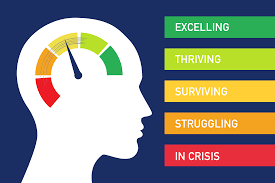
“So mental health is not a binary state – you are not either mentally healthy or ill. Our mental health falls on a continuum, ranging from excellent mental health to severe symptoms such as panic attacks or major depressive episodes”

Delphis.org.uk


Feeling a degree of stress at points within a term is normal and part of the profession, we all have pinch points through an academic year that can be pressured and stressful. We do need to remember that this is normal, as long as it remains manageable. However, we must be able to recognise if we begin to feel overwhelmed, overly stressed or anxious, which can then prevent us effectively fulfilling our role and responsibilities towards our families and students. This is where we begin transitioning from the thriving to the struggling zones on the continuum. Some of the characteristics of these zones are being distracted, withdrawn, losing our appetite, feeling nervous and sad, and having trouble sleeping. 

So what can we do if we feel we're descending to these zones? Well we must remember to prioritise our own self care, be honest with ourselves about things that aren’t absolutely necessary, and move them lower on our list to make room for some self-care to restore our wellbeing. What this self-care looks like for each of us is different - but finding time outside of work to do something you enjoy throughout the week is a great starting point, this could be exercise, reading a book or any other activity that can help us escape from built up anxieties. 


Talking to each other is another crucial self-care strategy. Talk about your issues and problems with your colleagues and those around you. Try using the ask twice approach - when we ask someone if they are OK the response is usually “yes- fine”... ask again! Asking twice allows that person to know you really do care and you do want to know the answer and are prepared to listen. 

If things are getting really tough ask for help - asking for help shouldn't be something to feel ashamed of, we all move up and down the mental health spectrum throughout our lives, there is absolutely no shame in reaching out and asking for help.  


For further information and reading try follwoing some of the links below:

Hannah Harwood - Assistant Headteacher

You can follow Hannah @hannahharwood4