Showing posts with label Passive Learners. Show all posts

Wednesday, 10 June 2020

Applying Growth Mindset theory to citizenship and oracy - Samantha Lewis

Research and development focus

Caroline Dweck developed Growth Mindset Theory in the early 2010's. The theory suggests we have two general mindsets - fixed and growth.


A fixed mindset is when we hold concrete beliefs about our ability in a given area - particularly that we are unable to improve that ability. Although this may sound undesirable a fixed mindset can be very useful. For example having a fixed mindset in our ability to fly, believing we are incapable and never able to improve, ensures we don't go jumping off cliffs! The problem occurs when we hold fixed mindsets in areas where we are capable of improving such as our intelligence or knowledge base. Dweck proposed that people who hold fixed mindsets believe that intelligence and ability are something we are born with and as such are limited. If they fail at something, a person with a fixed mindset would conclude that this is the best they can do and, as such, they will avoid challenge and give up easily. In schools this can manifest itself as passive and disengaged learners who underachieve.


On the other hand people who hold a growth mindset believe their most basic abilities can be developed through dedication and hard work. They see failure as an opportunity to learn and believe that their intelligence is malleable and able to change.


Fixed v. Growth Mindset - Leadership - Medium

Through discussions in our research and development group we agreed that many of our students at Denbigh lack the self belief to have a growth mindset. Many had fixed mindsets in certain subjects and as such had almost given up in them. We recognised that as teachers we need to find ways to change students thinking from “we can’t do this” to “we can do this if we try XYZ”


Literature Review

Dweck argued that students who fail to succeed in a subject do so because they simply believe they are not good at it. These students have a predetermined belief about their ability and assume that they are going to fail - because of this they do not even try, as any effort would be a ‘waste’. Dweck writes  “In the fixed mindset, everything is about the outcome. If you fail—or if you’re not the best—it’s all been wasted. The growth mindset allows people to value what they’re doing regardless of the outcome. They’re tackling problems, charting new courses, working on important issues. Maybe they haven’t found the cure for cancer, but the search was deeply meaningful,” (Dweck, 2015). Dweck conducted research in schools to find out whether mindsets had an impact in achievement in maths. In it she found that students who had fixed mindsets underperformed compared to those who had a growth mindset.


Dweck's research also looked at ways to change a fixed mindset into a growth mindset. She suggested that teachers can support students in transitioning from fixed to growth mindsets by praising for effort - not ability, and also by providing strategies to help students overcome the hurdles they have in their learning. 


Dweck speaks about the power of having a growth mindset in this video.

Jo Boaler, an education author on growth mindset theory, also recognised the important role teachers have in changing the mindset of students;

“Yes, we have differences in our brains and cognitive processes, but it is important to recognize that people who accomplish much demonstrate tenacity and discipline. Their learning is a result of their hard work, not simply because of natural talent. Students with a fixed mindset think that if a task is too hard it must mean they do not have the natural talent to succeed. We [as teachers] must help students realize that errors, misconceptions, and questions, if analyzed constructively, help us deepen our knowledge and understanding.”

As teachers we must ensure that the students with a fixed mindset are tackled to change the way in which they think in order to unearth their natural talent, once this is unearthed the possibilities for that student are endless. As teachers we must recognise the potential of each and every student to enable them to develop their knowledge.

Intervention

I focussed my intervention on my year 7 citizenship group. They are lower ability and there are many of them who believe that they are incapable of achieving higher grades, regardless of the effort, so they give up. They also lack confidence to speak in front of class without reading from a pre-prepared script. This can be a common problem in lower ability groups generally. The main barrier for these students was their self belief, not recognising their own potential and therefore not engaging in their learning as much as they could. 


The intervention followed three steps:

  1. Designing a scheme of work which will help the students understand mindset theory and recognise their own fixed and growth mindsets in relation to citizenship and oracy.

  2. Through teaching the scheme of work an attempt will be made to change any students' fixed mindsets into growth mindsets by consistently referring to growth mindset qualities using posters placed in the classroom as well as praising for effort as opposed to intelligience.

  3. A summative interview to measure the impact of the intervention including whether their mindsets had changed.

Overall, I hoped to see some change in the students' way of thinking as well as their confidence in themselves to be able to improve.


Implementation

At the start of the process a lesson was held that taught basic mindset theory which also identified the type of mindset the students had in citizenship. I found the majority generally had growth mindsets however they had a fixed beliefs about their ability to achieve as highly as top set students and in their ability to present to a class without reading off slides or notes. A small number of students with general fixed mindsets were also identified.


After this starting lesson, I adapted an existing citizenship scheme of work where students had to design their own nations (applying previous learning about British values such as democracy, tolerance and respect, individual liberty, and the rule of law). The scheme of work encouraged them to debate scenarios that would encourage them to create their own rules and ways of governing a small society through discussion and problem solving. At various points students were reminded about having a growth mindset, particularly when they reached difficulties. They were encouraged to seek help when they needed it from their peers first and then the teacher second (who would then give them a strategy to solve the problem or model it for them). High levels of praise and encouragement were given to students putting effort into the task even if these efforts floundered.


How to get out of presenting in class - Quora
One of the desired impact of the project was to improve mindset towards oracy activities.


The scheme of work culminated with an oracy activity where they had to present the ideas of their new nation to the rest of the class. Whereas in the past students often read from a script in presentations, they were asked to speak using only note cards. This was modelled by the myself and pupils were encouraged to practice in small groups before delivering a class presentation.


Impact

It was clear through the presentation task that the majority of students had adopted growth mindsets in both the citizenship and oracy task - all of the groups delivered presentations without scripts with many individuals vastly improving. Even those who did not improve drastically put more effort into the task - responding well to praise.


After the completion of the scheme of work, I also interviewed some of the students about their perception of growth mindsets and whether they felt they had an improved mindset to citizenship and oracy. From these interviews it was clear that their knowledge of mindsets was evident and that they had consciously thought about the way their mindset had affected the way they had performed in the lessons. One pleasing comment from a student was: "I am smarter than I think I am!”


Recommendations

  • Always praise for effort. This will encourage students to continue trying and not give up.

  • For any students struggling to apply a growth mindset, remember as a teacher you should still provide scaffolds for tasks students find difficult. For weaker groups you can always break down more complex tasks into smaller ones to help students make progress.

  • Have a simple growth mindset display board in your classroom to remind students of the characteristics of a growth mindset.

A short explanation of the impact that praising for effort ahs over praising for intelligience.

Further Reading

It is important to note that there are many critics of growth mindset theory and that, although the principle can be useful and have an impact if used in conjunction with other sound teaching and learning strategies, applied in isolation it can be ineffective. These two posts are critical of the theory:


You can follow Samantha Lewis on twitter @MrsSLewis1

Wednesday, 29 January 2020

Engaging Passive Learners in RE through adaptive learning - Masuma Tafadar

Research and development focus
A passive learner is one that engages in learning at a superficial level; rather than be interested in thoughtful enquiry a passive learner will process information, such as copying or reading, without actually thinking about its meaning and therefore fail to encode any of the information into their long term memory and make any meaningful progress. 

The key question for teachers is to understand where this passivity comes from. In some cases it can be to do with a student's home life; through an upbringing of low expectations and a lack of parental engagement in the child's learning, a habit of passivity towards education can be developed. This and the wider problem of low cultural capital can cause passivity in the classroom - a problem that is difficult for an individual teacher to address. 


Another possibility is that students may not be receiving enough or the correct differentiated or scaffolded learning. This may mean that students are not able to access the information they are being taught in a meaningful way. This can lead to disengagement and student acceptance that they cannot exert control over their learning process. This inhibits the progress and growth of the individual and as a result de-motivates the student - this can lead to behavioural challenges including passivity. In this case an individual teacher can make a difference and this will be the focus of my research.


Image result for cultural capital
A poverty in cultural capital can mean a student lacks the habits of engaging in learning discussions making it difficult for them to access education, a subsequent failure in education can then lead to demotivation and passivity.
The aim of my research is to engage year 11 low-middle ability students who are extremely passive and disengaged learners. Many of these students lack focus and find it difficult to concentrate and stay on task. They lack motivation to do their work and often copy from the board, text-book or partner without engaging in the knowledge content and attempting to understand or process the information. They also struggle answering exam questions and do not use the differentiated worksheets/task-sheets effectively to help them answer the questions. Some of the students have very little confidence in themselves and have a negative outlook towards the work and the exam results; often saying they thought they would fail their GCSE exams.


In preparation for the GCSE exams, students needed to gain curriculum knowledge as well as practice exam skills. The 12 mark question was particularly challenging for them as they were required to evaluate a statement and formulate a thoughtful response with evidence to support their opinions. Although students had a planning sheet they rarely achieve more than 3 marks despite giving a lengthy answer. This only demotivated them and resulted in low self confidence.

Literature Review
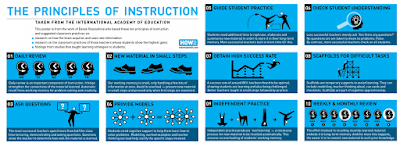
A change in how information is received, interpreted and used can have a profound impact on student outcomes. In Principles of Instruction, Rosenshine presents 10 research-based principles of instruction. These principles come from three sources: (1) research in cognitive science, which focuses on how our brains acquire and use information; (2) research on master teachers, and (3) research on cognitive supports to help students learn complex tasks. This is effective instructional procedures, such as thinking aloud, providing students with scaffolds, and providing students with models. The focus of this research would be to explore point 3 - research on cognitive supports to help students learn complex tasks.


Image result for rosenshine principles


One principle is to present new material in small steps with student practice after each step. Small amounts of new material is presented at any time, and then students are assisted as they practice this material. This is because our working memory is small. It can only handle a few bits of information at once and too much information swamps our working memory. Presenting too much material at once may confuse students because their working memory will be unable to process it.

Providing students with models and worked examples can help them learn to solve problems faster. Rosenshine mentions that students need cognitive support to help them learn to solve problems. Teacher modelling and thinking aloud while demonstrating how to solve a problem are examples of effective cognitive support. Worked examples are another form of modelling that has been developed by researchers. Worked examples allow students to focus on the specific steps to solve problems and thus reduce the cognitive load on their working memory.


Providing students with scaffolds for difficult tasks: The teacher provides students with temporary supports and scaffolds to assist them when they learn difficult tasks. Scaffolds or instructional supports help students learn difficult tasks. These temporary supports are gradually withdrawn as learners become more competent, although students may continue to rely on scaffolds when they encounter particularly difficult problems. Providing scaffolds is a form of guided practice. Scaffolds include modelling the steps by the teacher, or thinking aloud by the teacher as he/she solves the problem.


Image result for scaffold learning
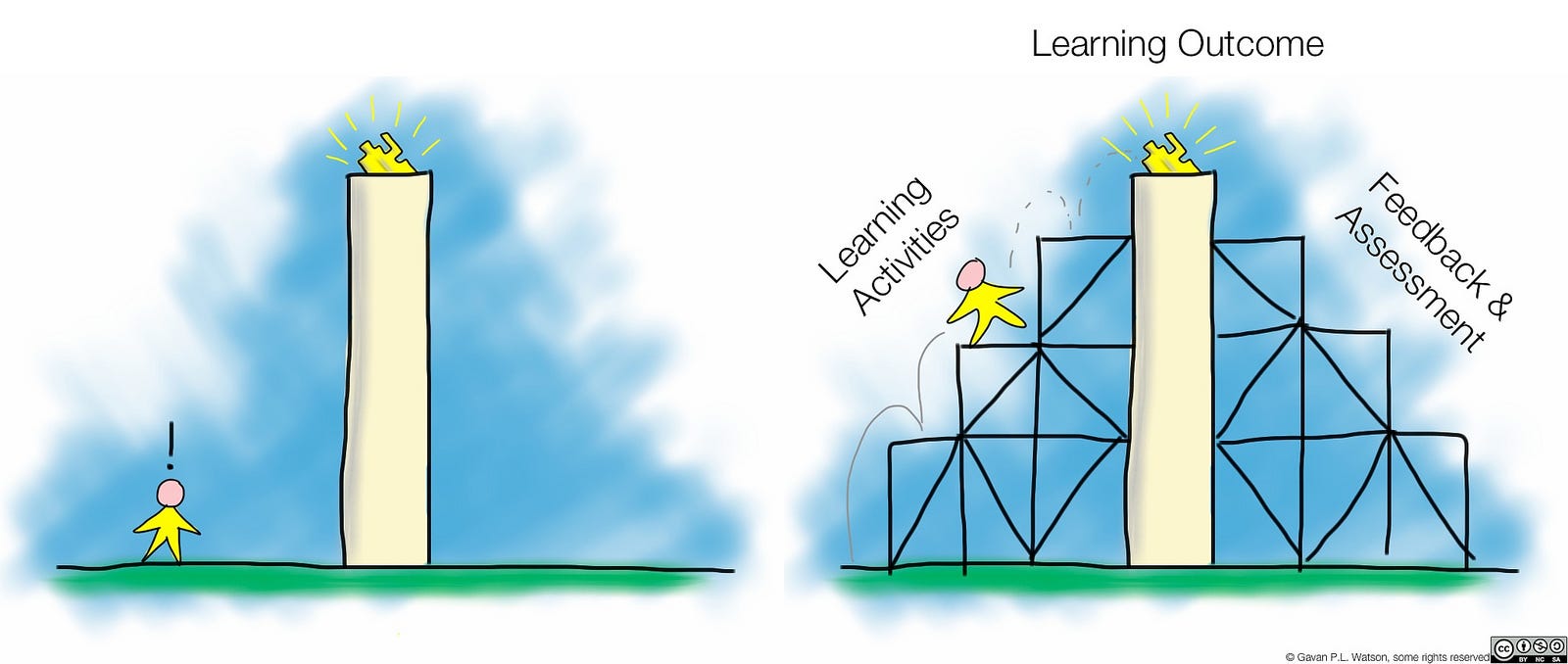
Providing scaffolded tasks for learners can make daunting tasks achievable and increase motivation.
Additionally, it has also been found that scaffolding helps students learn more by working with a teacher to achieve their learning goals. Through research, Vygotsky found that children needed to interact with others who are more intelligent than they currently are in order to learn. These instructors or peers are the “scaffolding” who help the student expand their learning boundaries and learn more than they would be able to on their own.

Furthermore, Nicolas Pino-James mentions in the 'Golden Rules for Engaging Students in Learning Activities' that it is important to foster a sense of competence. The notion of competence may be understood as a student's ongoing personal evaluation of whether he or she can succeed in a learning activity or challenge. Schunk and Mullen (2012) have found that effectively performing an activity can positively impact subsequent engagement. To strengthen students' sense of competence in learning activities, the assigned activities could include feedback that helps students to make progress.

Intervention
The sample group used were 6 passive students from my year 11 GCSE class. The students were between 15-16 years old and a mixture of male and female students. The intention was to help improve their answers to 12 mark exam questions and also to help students evaluate their knowledge and to change their mindset to a positive attitude and reduce passivity.

I created and designed a template which students can use to plan and write an answer to a 12 mark exam question. Prior to this, students were using a template to plan an answer, however, they were unable to process the information or evaluate in a meaningful way.

To help scaffold the learning and in addition to the template, I created a colour coded template on a display board. Whilst they were using the template to plan their answer, I used the display to give direct instruction. I instructed them on what sections I wanted them to work on. This meant that they were not overwhelmed with the task and that it was manageable. I also provided examples so students understood what they had to do in each section. I looked through answers as students were working and gave feedback.

Display board showing the strategy
Example of a template used in the intervention

The evidence I collected are the answers they have written for 12 mark questions before using the template and then the answers given after using the templates. This helped to understand whether, this template and the method of breaking it up into manageable tasks, coupled with instruction improved their answers. I also interviewed students to gain an insight on there mindset and the effectiveness of the support as well as made casual observations.

Impact
The intervention was successful for 1 student out of the 6. The student was able to identify what was required of him and how to structure the answer. He was able to follow instruction well and went from a negative mindset and feeling like he would fail to becoming much more positive about his efforts and his outlook on the exam. Furthermore, giving feedback motivated him to work hard and learn. He felt much more confident in attempting to answer a 12 mark question and about his exam in general. He spoke about how hard he was revising for RE; this change in attitude was a great improvement in comparison to his attitude before.


1 out of 6 kids in Montana will experience hunger during their childhood
5 out of 6 students did not show a significant change in attitude or improvement in their answers. Some mentioned they found the simplified template still too complicated to use and were used to the previous template. However, on further questioning the students revealed that, due to gaps in their knowledge due to previous passivity, they lacked the desire to make improvements in this late stage of their education. Nevertheless, I found that the structure helped other students (those not part of this focus group) who struggled with answering questions and did not know how to put their thoughts into words effectively.

Further research
For further research, I would like to work with a larger focus group of passive students and low achieving students in year 7 and collate the evidence up until their GCSE exams. I believe this would result in more reliable data and also have a bigger impact on their engagement as a problem like passivity needs to be pre-empted in earlier year groups. I would also interview students at the beginning and end of the process to get a better idea of their mindset and how they found the template I created. This would give a good idea of whether students were passive due to disinterest or because they genuinely struggled.

Recommendations
  • Scaffold learning by breaking down new or complex skills or knowledge into smaller parts. After introducing each new part, practice it first before moving on to the next task.
  • Be aware of the reasons behind a students passive nature. In my focus group, some students did not believe they could achieve their target grade and did not believe in themselves, in which case they can be helped through my intervention. However, some lacked motivation to learn or work at all, simply because they lacked motivation in a subject due to historic passivity and other issues beyond the classroom. This is not something that can be helped by my intervention alone. If students are passive for this reason then other measures and motivational techniques need to be devised.
References


Wednesday, 20 November 2019

Engaging Passive Learners in Mathematics - Muhammad Haroon

Research and development focus
Every teacher, regardless of experience, has come across a passive learner during their teaching career. The issue with passive learners is that they are rarely disruptive. This means they often go unnoticed and unchallenged. This lack of challenge results in poor progress and ultimately a child who is let down. Therefore, my main focus is to research different techniques which can be used to encourage passive learners to be more involved during lesson time, this in turn can increase student achievement. Research shows (and common sense implies) that there is a clear positive correlation between these two variables.
Image result for passive students
Passive learners often go unnoticed and unchallenged.
Literature Review
Engaging students is the clear antidote to passivity. According to Meier (2008), one way of engaging students is by making learning relevant to them by connecting it to a student's life experience. Getting students to solve authentic real life problems based upon experience, such as working out phone bills, can support them beyond the four walls of a classroom and give a subject value, thus engaging them. It was also discovered that students found it easier to solve problems and remember the techniques used when they were connected to life experiences thanks to links to prior knowledge the students already possess.

Another way to increase engagement is by getting students to collaborate with each other, either in pairs or in small groups as this also allows students to share and build their ideas and make themselves feel included and responsible for their own learning. Lastly, getting students to develop and use their higher order thinking skills such as analyzing, interpreting, and/or manipulating information has shown to improve engagement as a form of challenge. The key issue however, is how we can implement these strategies effectively.

Image result for manchester metropolitan RME

Intervention
The Realistic Maths Education (RME) project is a resource which has taken over 14 years to research and design by academics at Manchester Metropolitan University. I have been given several resources over a span of two years to help improve the teaching of mathematics from this project. Each module is designed to be completed over two weeks.

I will be using RME strategies with my two year 7 classes and monitor two passive learners from both of them. These students tend to lose focus or interest very quickly and I have to continuously remind them to either focus on what I am teaching or on completing their work.

Having attended the training days, I learnt different strategies for engaging students. I intend to use these techniques such as getting students to draw their solutions to problems onto the class whiteboard and hand over a degree of ownership of the work as well as setting problems that relate to their prior knowledge. The resources used in the lessons have been shown in other contexts to engage and therefore reduce passive learners and so improve the students results as well as their problem solving mathematical skills.

I intend to keep track of the passive students and take note of any passive or engaged behaviours shown during the lessons in which I use the RME strategies as well as ask their perceptions of the strategies.

Image result for student at whiteboard
Encouraging students to own sections of learning by writing answers on a class whiteboard can engage learners.
Implementation and Impact
After planning and delivering the first session of the RME project, there was some improvements as the students were more engaged when I gave them a responsibility during a group discussion or when I gave them ownership of their work when presenting to the class. However, unless it was one of those two scenarios, the students were still passive during the lessons. When I asked the students how they were finding the strategies their responses were unresponsive and they claimed that they would rather do book-work. This was expected as we were told this was a common initial reaction from the students as it is a big change on how the style of teaching and learning.

When I taught the second module, one of the students was given a red, amber and green card. They were asked to show me one of the cards depending on how engaged they felt during the lesson. During my two period 5 lessons (end of the day), the student always showed an orange or red card which indicated that he was going to do some work or very little work. For this reason I was unable to see any impact of the RME strategies during these lessons. However, during the other two lessons, the student was very engaged and preferred taking part in the RME strategies instead of doing a standard book-work lesson. I did a short interview with the student in which they stated that they enjoyed the lessons more as they saw the relevance of the topics covered during these lessons. However, it is a concern that the uncontrollable variable of the time of the lesson counteracted the positive effects of the RME strategies.

Other students also showed some limited improvement. They were more interested and focused during certain activities however for much of the lesson the student still demonstrated passive behaviour and regular prompts had to be used during the lesson to keep them focused. I have completed several modules with this student but I am still going to continue to use the RME modules with other techniques to see if the student can become further engaged.

Image result for teaching
The holy grail of a fully engaged classroom can be achieved!
In conclusion, so far the students have made some progress but there is still a lot of room for further sustained development to be made. The problem is that there are many reasons as to why a student might be passive. Some students have fixed mindsets of their ability in maths, others are yet to see value in the subject, whilst other students may have other unknown reasons that extend beyond the classroom affecting their ability to become engaged. Nevertheless, the RME project has had an initial impact on the students and as such I will continue to use this resource to create a sustained culture change in teaching and learning. However other whole school strategies such as linking maths to career pathways and future aspirations could be applied to motivate and combat passivity as a separate approach to this complex issue.

Further research
I intend to continue using this resource with the students in year 8 and continue monitoring how the modules can help engage and reduce passive learners in the classroom over a longer period of time. My research will go on to support a wider project led by academics at Manchester Metropolitan University.

Recommendations
  • Be persistent when implementing new strategies, at first they may not work but over time they can lead to a change in culture and help achieve marginal gains.
  • Link learning and problem solving to other areas were students may have prior knowledge - this can be from previous learning or from their life experiences. 
  • Present students with an opportunity to own sections of their learning.
References and further reading
Muhammad Haroon - Teacher of Maths

You can follow Muhammad on twitter:

@MHaroon54