Showing posts with label Research and Development. Show all posts

Wednesday, 29 January 2020

Engaging Passive Learners in RE through adaptive learning - Masuma Tafadar

Research and development focus
A passive learner is one that engages in learning at a superficial level; rather than be interested in thoughtful enquiry a passive learner will process information, such as copying or reading, without actually thinking about its meaning and therefore fail to encode any of the information into their long term memory and make any meaningful progress. 

The key question for teachers is to understand where this passivity comes from. In some cases it can be to do with a student's home life; through an upbringing of low expectations and a lack of parental engagement in the child's learning, a habit of passivity towards education can be developed. This and the wider problem of low cultural capital can cause passivity in the classroom - a problem that is difficult for an individual teacher to address. 


Another possibility is that students may not be receiving enough or the correct differentiated or scaffolded learning. This may mean that students are not able to access the information they are being taught in a meaningful way. This can lead to disengagement and student acceptance that they cannot exert control over their learning process. This inhibits the progress and growth of the individual and as a result de-motivates the student - this can lead to behavioural challenges including passivity. In this case an individual teacher can make a difference and this will be the focus of my research.


Image result for cultural capital
A poverty in cultural capital can mean a student lacks the habits of engaging in learning discussions making it difficult for them to access education, a subsequent failure in education can then lead to demotivation and passivity.
The aim of my research is to engage year 11 low-middle ability students who are extremely passive and disengaged learners. Many of these students lack focus and find it difficult to concentrate and stay on task. They lack motivation to do their work and often copy from the board, text-book or partner without engaging in the knowledge content and attempting to understand or process the information. They also struggle answering exam questions and do not use the differentiated worksheets/task-sheets effectively to help them answer the questions. Some of the students have very little confidence in themselves and have a negative outlook towards the work and the exam results; often saying they thought they would fail their GCSE exams.


In preparation for the GCSE exams, students needed to gain curriculum knowledge as well as practice exam skills. The 12 mark question was particularly challenging for them as they were required to evaluate a statement and formulate a thoughtful response with evidence to support their opinions. Although students had a planning sheet they rarely achieve more than 3 marks despite giving a lengthy answer. This only demotivated them and resulted in low self confidence.

Literature Review
A change in how information is received, interpreted and used can have a profound impact on student outcomes. In Principles of Instruction, Rosenshine presents 10 research-based principles of instruction. These principles come from three sources: (1) research in cognitive science, which focuses on how our brains acquire and use information; (2) research on master teachers, and (3) research on cognitive supports to help students learn complex tasks. This is effective instructional procedures, such as thinking aloud, providing students with scaffolds, and providing students with models. The focus of this research would be to explore point 3 - research on cognitive supports to help students learn complex tasks.
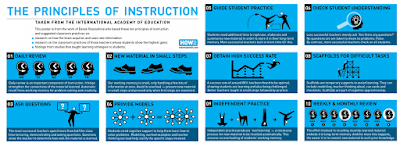

Image result for rosenshine principles


One principle is to present new material in small steps with student practice after each step. Small amounts of new material is presented at any time, and then students are assisted as they practice this material. This is because our working memory is small. It can only handle a few bits of information at once and too much information swamps our working memory. Presenting too much material at once may confuse students because their working memory will be unable to process it.

Providing students with models and worked examples can help them learn to solve problems faster. Rosenshine mentions that students need cognitive support to help them learn to solve problems. Teacher modelling and thinking aloud while demonstrating how to solve a problem are examples of effective cognitive support. Worked examples are another form of modelling that has been developed by researchers. Worked examples allow students to focus on the specific steps to solve problems and thus reduce the cognitive load on their working memory.


Providing students with scaffolds for difficult tasks: The teacher provides students with temporary supports and scaffolds to assist them when they learn difficult tasks. Scaffolds or instructional supports help students learn difficult tasks. These temporary supports are gradually withdrawn as learners become more competent, although students may continue to rely on scaffolds when they encounter particularly difficult problems. Providing scaffolds is a form of guided practice. Scaffolds include modelling the steps by the teacher, or thinking aloud by the teacher as he/she solves the problem.
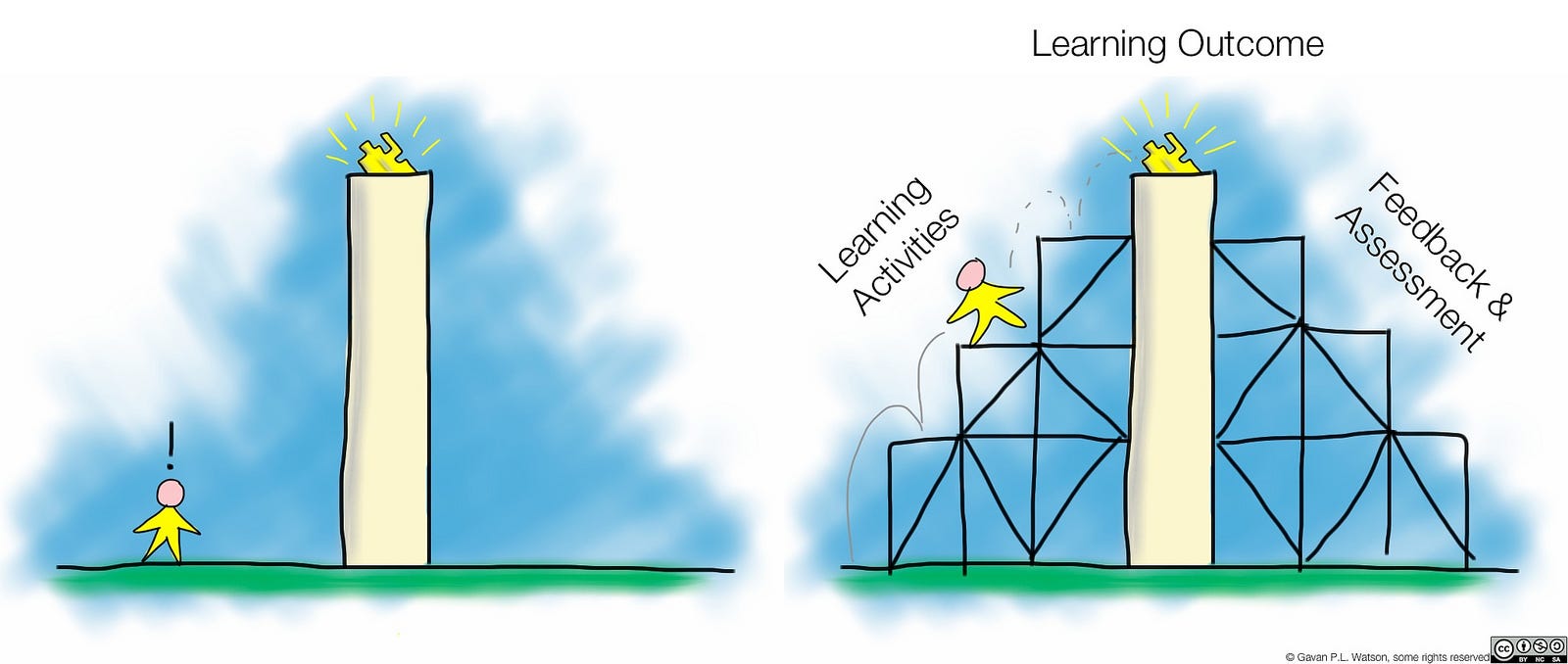

Image result for scaffold learning
Providing scaffolded tasks for learners can make daunting tasks achievable and increase motivation.
Additionally, it has also been found that scaffolding helps students learn more by working with a teacher to achieve their learning goals. Through research, Vygotsky found that children needed to interact with others who are more intelligent than they currently are in order to learn. These instructors or peers are the “scaffolding” who help the student expand their learning boundaries and learn more than they would be able to on their own.

Furthermore, Nicolas Pino-James mentions in the 'Golden Rules for Engaging Students in Learning Activities' that it is important to foster a sense of competence. The notion of competence may be understood as a student's ongoing personal evaluation of whether he or she can succeed in a learning activity or challenge. Schunk and Mullen (2012) have found that effectively performing an activity can positively impact subsequent engagement. To strengthen students' sense of competence in learning activities, the assigned activities could include feedback that helps students to make progress.

Intervention
The sample group used were 6 passive students from my year 11 GCSE class. The students were between 15-16 years old and a mixture of male and female students. The intention was to help improve their answers to 12 mark exam questions and also to help students evaluate their knowledge and to change their mindset to a positive attitude and reduce passivity.

I created and designed a template which students can use to plan and write an answer to a 12 mark exam question. Prior to this, students were using a template to plan an answer, however, they were unable to process the information or evaluate in a meaningful way.

To help scaffold the learning and in addition to the template, I created a colour coded template on a display board. Whilst they were using the template to plan their answer, I used the display to give direct instruction. I instructed them on what sections I wanted them to work on. This meant that they were not overwhelmed with the task and that it was manageable. I also provided examples so students understood what they had to do in each section. I looked through answers as students were working and gave feedback.

Display board showing the strategy
Example of a template used in the intervention

The evidence I collected are the answers they have written for 12 mark questions before using the template and then the answers given after using the templates. This helped to understand whether, this template and the method of breaking it up into manageable tasks, coupled with instruction improved their answers. I also interviewed students to gain an insight on there mindset and the effectiveness of the support as well as made casual observations.

Impact
The intervention was successful for 1 student out of the 6. The student was able to identify what was required of him and how to structure the answer. He was able to follow instruction well and went from a negative mindset and feeling like he would fail to becoming much more positive about his efforts and his outlook on the exam. Furthermore, giving feedback motivated him to work hard and learn. He felt much more confident in attempting to answer a 12 mark question and about his exam in general. He spoke about how hard he was revising for RE; this change in attitude was a great improvement in comparison to his attitude before.


1 out of 6 kids in Montana will experience hunger during their childhood
5 out of 6 students did not show a significant change in attitude or improvement in their answers. Some mentioned they found the simplified template still too complicated to use and were used to the previous template. However, on further questioning the students revealed that, due to gaps in their knowledge due to previous passivity, they lacked the desire to make improvements in this late stage of their education. Nevertheless, I found that the structure helped other students (those not part of this focus group) who struggled with answering questions and did not know how to put their thoughts into words effectively.

Further research
For further research, I would like to work with a larger focus group of passive students and low achieving students in year 7 and collate the evidence up until their GCSE exams. I believe this would result in more reliable data and also have a bigger impact on their engagement as a problem like passivity needs to be pre-empted in earlier year groups. I would also interview students at the beginning and end of the process to get a better idea of their mindset and how they found the template I created. This would give a good idea of whether students were passive due to disinterest or because they genuinely struggled.

Recommendations
  • Scaffold learning by breaking down new or complex skills or knowledge into smaller parts. After introducing each new part, practice it first before moving on to the next task.
  • Be aware of the reasons behind a students passive nature. In my focus group, some students did not believe they could achieve their target grade and did not believe in themselves, in which case they can be helped through my intervention. However, some lacked motivation to learn or work at all, simply because they lacked motivation in a subject due to historic passivity and other issues beyond the classroom. This is not something that can be helped by my intervention alone. If students are passive for this reason then other measures and motivational techniques need to be devised.
References


Wednesday, 11 December 2019

Getting involved in evidence informed practice: Research and Development at Denbigh - Ian Stonnell

The trend in education over the past few years has been towards an 'evidence informed' approach to teaching and learning. This, in short, is the idea that strategies that we employ in the classroom should be empirically tested in some way so to be given a rubber stamp that says "this works - look! there is evidence to prove it! We should all do it!" - This sounds like a perfectly reasonable idea, especially compared to the past where many strategies appeared to be based on the latest educationalist trend rather than any solid evidence base.

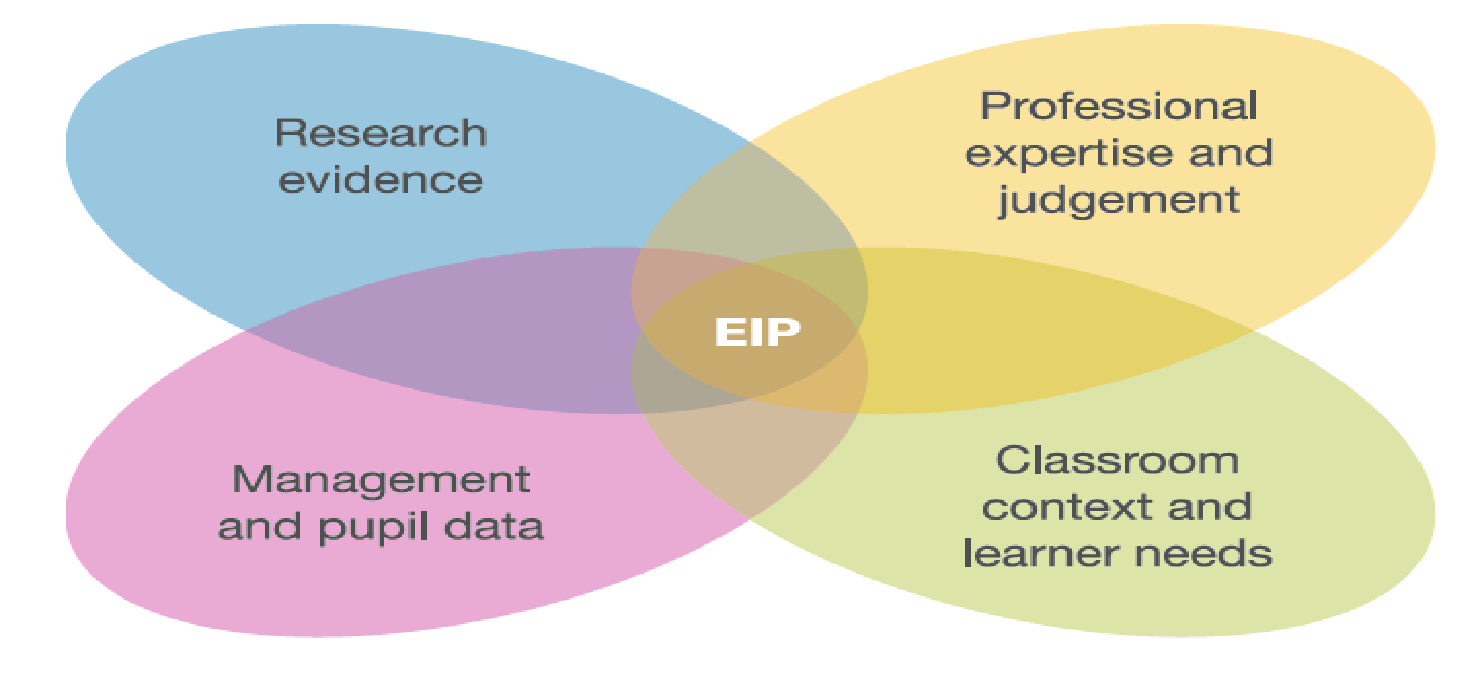
An evidence informed practice (EIP) model.
At Denbigh we have tried to encourage a more evidence informed approach by trying to support staff in an outward focus toward the research evidence. However, there have been problems in doing this. Firstly, trying to filter through all of the burgeoning research is not an easy task. Finding credible research is often a confusing and time consuming job that teachers struggle to make the time for. Thankfully, there are some great filters out there; from the large organisations like the Chartered College of Teaching or ResearchED to the growing numbers of bloggers who are engaging with the research and trying to make it meaningful to the classroom teacher. Twitter probably remains the easiest way for individual teachers to engage in discussions on the the latest research evidence. Also, in many schools like Denbigh, leaders are trying to act as filters themselves by presenting some the best evidence informed practice to teachers directly.

Image result for researchEd
Organisations like ResearchED are useful to teachers as they to a lot of the filter a lot of the best research.
Nevertheless there is still a problem. Unfortunately education is not an empirical science - it is a social one. We are dealing with human beings (both students and teachers) who are complex, subjective and individual. Any given evidence informed strategy, by itself, could be affected by so many other variables that knowing for sure it is the strategy that is making the difference is difficult. The reasons why a strategy may work or fail could just be down to doing something different (a kind of placebo affect) or maybe it works or fails because of the way it is implemented. Replicating a successful strategy from one school to another is also not a simple copy and paste job as school contexts are vastly different. Therefore relying on research based strategies from beyond our school is not going to be enough.

This is the reason why that, just because a strategy may have evidence to support its efficacy in another school or in academia, it doesn't mean it is going to work for us straight away, if at all, in our context. That is why we need to employ our own professional expertise and judgement and our understanding of our own unique contexts to any new strategy. We need to see what works for ourselves by engaging in our own research.

Image result for research
Studying human behaviour including learning is a difficult task - we are very complicated animals.
The Denbigh Model of Research and Development.
So at Denbigh this is what we are trying to do. Firstly we have introduced all staff to one area of research focus (we have done some filtering). Secondly, we have tried to give some time for all staff to understand, discuss and reflect upon that research and the potential strategies that they imply in teaching and learning. Now, as we go into the spring term, if we have not already begun to do so, we intend to implement these new strategies in our teaching to test whether they make an impact. Now how do we do this research? 

Firstly lets remember we are not engaging in academic research, we are engaging in small-scale action research. It's not meant to be that complicated. Below is a simple step by step guide on how to do it.
  1. Intent - Define the aim - What are you trying to achieve?
    • In our research groups we may have discussed our ideas and aims. An example: "I am aiming to improve the long term memory retention of year 10 GCSE RE students knowledge of Christian beliefs with a particular focus on middle ability year 10 boys who have last year underachieved in comparison to other gorps." Notice it is clear and measurable and links to a specific set of knowledge. 
  2. Implementation - The strategy - How are you going to do it?  
    • This is where we think about how we can bring about the aim. This should relate to the research and related strategies we have discussed in our research groups. My example: "I plan to achieve my aim by implementing a method of dual coding in my Google slide presentations and exercise books based upon the principles of cognitive load theory as well as plan regular low stakes retrieval practice tasks in lessons." Notice that this is not overly complex - when I come to write it up/present it I will elaborate and give more detail.
  3. Impact - The evidence - How will you know it is successful?
    • Firstly you will take a sample of a group you are looking to assess the impact in. I could look at the entirety of year 10, a class or a small sub group within a class... it depends what our aim is. You will also need to collect some evidence to show an impact. Much of this evidence will occur naturally, such as assessment data, exercise books/steps to success data etc. Some data you may actively collect such as a student questionnaire or simple student interview which could take place informally during a lesson. Whatever you decide to collect it shoud not be a laborious process, the simpler the better. Take the following example: "I will be implementing the strategy with all my year 10 classes however I will focus on my middle ability boys who in RE have been underachieving at GCSE in comparison to other groups. I will interview a small sample before the strategy is implemented and then at the end - asking them questions of their long term memory and their perceptions of the strategy. I will also look at their performance in retrieval practice tests and the end of unit assessments over the spring term and compare them to previous test scores." From this data I should be able to determine whether the strategy has had a positive impact or not and make some conclusions.
During the spring term most of us, if we have not already started, will be implementing new strategies and begin collecting some data. By Easter and the early part of the summer term we certainly should be able to notice whether these strategies have made an impact and hopefully share some of the best ideas with all of us at our summer professional development day and through the Denbigh teaching and learning journal and blog.

Image
The Adam Boxer session and the importance of the knowledge rich curriculum has inspired many new strategies in my own teaching this year - hopefully they have inspired some new ideas for you too.
What are the benefits of this process?

It is important to remember is in itself based on evidence as a way to improve teaching and learning and outcomes. In short here are three benefits:
  1. We will become better teachers. By taking part in reflective practice such as this we will become a staff body that is constantly looking for ways to improve and get better. Engaging in research will help us become more informed of the best teaching and learning strategies and by conducting research we will be able to select the best ideas that work for us and implement them into our routine practice.
  2. We will create better learners. Many of the new strategies we implement will make a demonstrable positive difference to student outcomes. Whether they make huge differences or marginal gains it will be worth it.
  3. We become better leaders. By sharing our practice we will all become better leaders. Whether you are an NQT or a member of the senior leadership team, by engaging in research and sharing the outcomes we will begin to influence and lead other members of staff across the school and beyond. This generates a culture of leadership that everyone can be a part of.
Good luck engaging in your research in 2020. We as a senior leadership team are looking forward to hearing all the great new innovations that we will be happening soon.

Ian Stonnell

Monday, 14 October 2019

How do we make homework meaningful? - Ian Stonnell

Homework... long has it been the bane of many a teacher's working life - that annoying extra little bit of workload that so often feels like an add-on; something to do because we feel we should be doing it but perhaps not 100% sure why. And then when we set it... oh the battles it can create with those students who just don't get it done! It's understandable when some of us in the profession question the point of setting it at all!

However, this is probably going a bit too far. Instinctively we know there is a benefit to homework (there is), maybe what we need is just some convincing of what the benefit is, as well getting a better idea of what makes homework meaningful. Let's see what the research tells us.

Image result for detention
At it's worse homework can be a barrier to learning.
Homework can make a significant difference to student outcomes
In 2015 research was conducted into the effectiveness of homework as a strategy to to improve performance in maths and science [Fernandez-Alonso et al. 2015]. In short it found homework made a positive difference to outcomes. Below are some further thought provoking findings:
  1. Students who were set regular homework performed better compared to those who only received it occasionally.
  2. Frequency of homework was more important than the amount of time spent on an individual piece of homework.
  3. Students who completed there homework by themselves achieved on average 10% better than those who got help from their parents.
  4. More time spent on homework did not necessarily mean better outcomes.


Image result for homework
If students can't do the homework by themselves progress won't happen.

What makes homework effective?
Dylan William famously stated that 'most homework set is crap'. In Fernandez-Alonso' et al's, study they also acknowledge that a lot of homework set was inefficient and lacking in impact (i.e. overblown and too time consuming). Therefore, if we want the best outcomes from homework we need to consider what makes homework effective and efficient. Based upon Fernadez-Alonso's findings and other research by Vatterott we should think about the following questions when we plan and set homework:
  1. What is the purpose? If it has none, don't set it.
  2. Is it a good use of the time it requires to complete? If it's not, re-think it.
  3. Is it something that students perceive as meaningful? If they don't know its meaning, have we told them?
  4. Is it achievable - can students complete the homework without adult support? If they can't how can we blame them when they don't do it?
If the homework you plan has a positive answer to these questions then most likely it will be a motivational task that will have an impact and completion rates will increase.
Image result for improving results
Carefully considering why we set homework is the clear solution to making it meaningful.
The R&D group - A word from Ash Choudhury and Anna Walczynska 
In our first meeting we discussed the current state of homework practice across the school and acknowledged that whilst there were lots of great strategies taking place there were plenty of areas where things were not ideal. One of the main discussion points was what the main purpose of homework is - Is it about supporting memory and recall, rehearsing skills learnt in lesson, or a means to encouraging independent learning or research?

As a group we considered memory and recall to be the primary purpose, after all, knowledge should be at the core, although independent learning would be a positive side effect of the implementation of any homework strategy. Following our sharing of a range of memory recall strategies practitioners decided to draw on five that they felt could be useful models to base a sequence of homework tasks upon:
  • Over-learning
  • Spaced Repetition
  • Retrieval practice
  • Acquisition before application
  • Interleaving
  • Graphic/knowledge organizers
We will soon be planning and implementing some new homework strategies with these discussions in mind and look forward to letting you know what we find out.

If Denbigh staff have any questions feel free to speak to any member of the R&D group.

Ash and Anna

@ash_achoudhury
@AnnaWalczynska

Useful links:

Monday, 7 October 2019

Cognitive Load Theory and its implications on teaching and learning - Ian Stonnell & Ian Hayden

What is cognitive load theory? It sounds complicated. Well it is and it isn't.

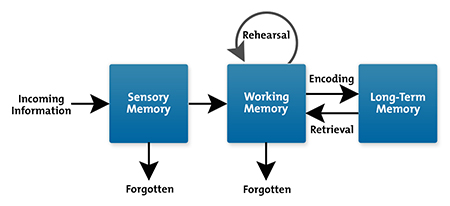
Put in its most simple terms cognitive load theory states that our brains have a limited working memory that can only process small amounts of new information from our environment. If we overload this working memory we are not going to be able to process it and therefore the new information will be forgotten.

Image result for cognitive load theory
A simple model of memory. The working memory is the part that we don't want to overload!

That's a problem for teachers. Today with the expectations of the new curriculum too often we teach at pace, overloading our students, and then wonder why they have forgotten everything we tried to teach them. We've all been there during exam revision when a class genuinely looks back at you with sincere eyes and say, "Sir, we can't ever remember you teaching us that topic". They probably aren't lying to you.

Image result for forgetting memory
If we have overloaded our students working memory chances are nothing was ever learnt in the first place.
However, the implications of cognitive load theory can give teachers a wide variety of strategies to help improve teaching and learning and support long term memory. We discussed two avenues of inquiry - (1) How can we alter the way we present information to minimise cognitive load? (2) How can we aid the retrieval of prior knowledge to aid transferring knowledge into the long term memory?

Willingham's simple model of the mind.

General strategies could be:
  1. When starting new concepts teach slow, accelerate later. 
  2. Consider the knowledge you want students to remember in each learning episode.
  3. Use explanation strategies that avoid overloading working memory and encourage connections with prior knowledge.
  4. Tie any new learning to knowledge already in the long term memory.
  5. Integrate retrieval practice strategies routinely into lessons to enhance student access to knowledge stored in the long term memory.
In our research group we discussed several specific strategies underpinned by cognitive load theory including:
  1. The take home strategy (as demonstrated by Adam Boxer).
  2. Knowledge organisers
  3. Interleaving and spacing
  4. Routine low stakes retrieval practice (including homework)
  5. Explanation strategies e.g. dual coding/direct instruction/worked examples.
Off course cognitive load theory is a lot more complex than how I have presented it here, however, I don't want to overload you with too much unnecessary information! If you want to know more about cognitive load theory and any of the other strategies feel free to peruse some of the links below or search for yourself!

Cognitive load theory and applications:
Knowledge organisers:
Dual Coding:
Retrieval practice:
Explanation techniques (based on understanding of CLT):
Interleaving and spacing:

Hope you find this helpful!

Ian Stonnell @DenbighCPD
Ian Hayden @IanHayden8


Wednesday, 2 October 2019

An experiment to develop the ability of students to ask meaningful questions - Shwab Choudry

Research and Development Focus
My focus was on passive and disengaged learners and I wanted to investigate the ability to challenge higher order cognitive thinking through questioning as a way to impact on passivity.

Questioning is perhaps one of the most vital adaptive skills to acquire for any individual. As defined in the Oxford dictionary, questioning is a matter which requires resolution or discussion (Oxford dictionary, 2017). If the right questions can provoke meaningful discussions pupils thinking and engagement can be supported. Therefore the effective use of questioning can help create challenges which can engage students as well as help students retain knowledge.

However, one of the problems which lay among students, is that many do not feel confident in asking questions. Other than the obvious reason that “questioning is a type of thinking some children find hard” (Board & Cross, 2014) it is in fact, the mindset of the pupils who get the impression that questioning irritates those who are in authority such as parents and teachers making them feel as if their questions are inappropriate to ask. It can be argued that students do not know how to ask pertinent questions and therefore this can act as a barrier between teachers and students (Schell, 1998). However, students have this notion built into them that asking questions can lead to embarrassment and the fear of being ridiculed (Schell, 1998). These could be some of the reasons to why a lot of the students are passive when it comes to putting their hands up to ask and answer questions.

Image result for school asking a question
How can we help students generate more meaningful questions?
Barriers to Student-Generated Questioning
There are many reasons why students are not encouraged to question. Teachers may need control and may feel pressure to cover established course content. If answering student questions takes too long, leads teachers away from their material, or requires teachers to enter content areas outside of their expertise, teachers may consciously or subconsciously discourage student-generated questioning.

Furthermore, some students have learned not to ask questions because those in authority such as teachers or parents have given the impression that questions are irritating or inappropriate. A history of receiving empty responses that are simply restatements of the question also inhibits students from questioning. In addition to prior experiences, students' decisions to ask questions are influenced by peer pressure, embarrassment, and fear of ridicule.

Not knowing how to ask pertinent questions can also act as a barrier. Natural inquisitiveness may be inhibited by current educational practices. Typically, students are comfortable asking nonacademic questions such as "What pages should we read in the book?" or "Will this be on the test?" but need guidance, time, and practice to develop their ability to use higher-level questioning. Students may also be accustomed to the use of questions from textbooks, student guides, and teacher guides in which experts identify problems and ask questions rather than having students doing so.

Intervention
I will be using a question grid which can support students to formulate questions during discussion activities. The grid has been structured to follow Bloom's taxonomy levels of questioning; acting as a classification system which assists teachers and students in recognising various levels of question asking. It is a 6x6 grid with the first 6 columns containing the questions who, what, when, why, where and how, and on the second part, there are six rows within a specific type of questions that prompts the user to ask different style of question. Inside the grid it gives an indication of how you might start a sentence with the question for example; ’when can it be….’ The further down the column and row the more challenging the question becomes.

Image result for blooms question grid
An example of a question matrix that can be used to help students generate questions.
I will be using my year 10 business class as a sample group as it has a mixture of boys and girls with different cognitive abilities and contains several passive learners. I will use the resource with a plenary game called ‘tell me, show me!’. This game consists of students writing down a question on a piece of paper and at the back, they would write or discuss the answer to it.  Students will use the grid to manipulate their questions.

I hope that during this activity many of the passive students will engage with the question setting and the discussions that can follow.

Implementation and impact
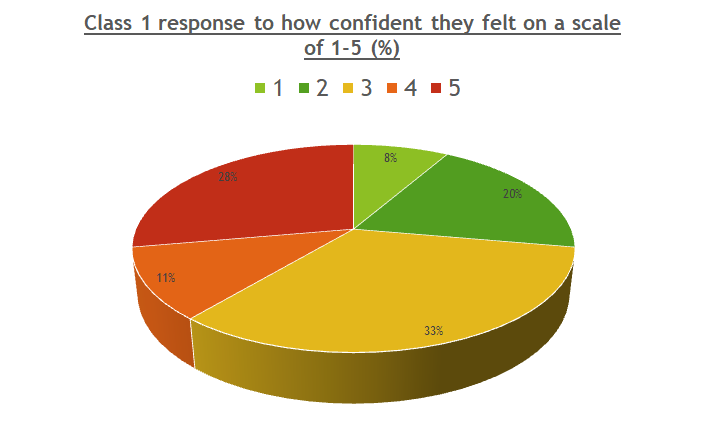
1 = Not confident
5 = Very confident
At the end of the trial I gave a questionnaire to the pupils for them to respond to in order to identify whether or not they had found the resource useful and their confidence in using it. The students response was largely positive. However, a large proportion of the class responded with a neutral or negative answer. Through further discussion I found out that some students saw it as just another task not a resource that promoted thinking or engagement. In addition to this higher ability students reported that they already felt confident in formulating their own questions and the resource became irrelevant. Nevertheless, with the passive students it did provide a way for them to engage in meaningful discussions as it helped the majority of these students in becoming more confident in participating in group discussion. They also reported that they enjoyed the activity and thought it was a fun and engaging exercise.

Further Research:
I feel there is enough evidence to suggest that the use of my question resource can engage learners. I would like to continue to use the question grid in different learning situations and assess the impact on different groups such as passive learners or lower ability students.

Recommendations
  • Questioning when used effectively can engage passive learners.
  • Encouraging students to formulate their own questions, using a resource like the one I have used, can encourage meaningful discussion and therefore engagement in a task.
  • Encouraging students to create their own questions also encourages independence and ownership over a piece of learning.

References
Denscombe, M (2010) The Good Research Guide, OUP
Kolbs learning theory (1984) cited online.(accessed 23.04.17)
Berger, W. (2014). A More Beautiful Question: The Power of Inquiry to Spark Breakthrough Ideas. New York: Bloomsbury.
Wiederhold, C., & Kagan, S. (2007). Cooperative Learning and Higher Level Thinking: The Q-Matrix. San Clemente: Hawker Brownlow Education.

Wednesday, 18 September 2019

Applying Memory and Recall Strategies to MFL - Annabelle Head

Research and development focus:
The focus of my research was in memory and recall. In relation to the teaching and learning going on in my MFL classroom, I wanted in particular to research a strategy that I could implement that would ensure that pupils commit grammatical knowledge to their long term memory. At present we cover grammatical points as and when they appear in the textbook. We practise that particular point in the context of that lesson and maybe revise that grammatical point in the following lesson before we move on to a new grammatical point. Although some pupils remember a particular grammar point learnt in the past, this is often a bit of a hit and miss situation and some will remember it in the long term but many will have forgotten days, weeks or months down the line. So, the aim is to research and find a particular method that I could employ in the classroom that would commit the grammatical points covered to the pupils’ long term memory as opposed to short term memory only.

Literature Review
Ian Stonnell recommended a book from the staffroom shelf by Daniel T Willingham called “Why Don’t Students Like School” and in particular, Chapter 3 (Why Do Students Remember Everything That’s on Television and Forget Everything I Say) However, my attention was also drawn to Chapter 5 (Is Drilling Worth It) and I ended up reading that one too. I also read 7 articles in the publication SecEd by Matt Bromley published in the first term of the academic year 2017/18.

Image result for why don't students like school

The main finding of my research was that you cannot store everything in your short-term memory. Therefore, things will not go into your long-term memory unless they have been in your working memory. Repetition and exposure are also obvious to make learning work. Whatever you think about is what you remember.  The implication for teachers is that they must therefore plan and organise ideas/material in a coherent way so that students will understand and remember it and give maximum exposure to those ideas/that material. Students must practise regularly in order to learn the facts and skills they need.  It is impossible to become proficient at something without extended practice and drilling is an excellent way of using the working memory. Practice makes memory long lasting. You get longer lasting memory because you practise more and because your practice is stretched over time. Practice also improves transferring what you already know to new contexts/situations. But what should be practised? If practice makes mental processes automatic, what needs to become automatic?  The answer is the building blocks of skills.  Building blocks are the things that are done again and again in a subject area and they are the prerequisites for more advanced work e.g. grammar in a modern foreign language.

Intervention
The aim is to focus on my year 7 groups, both A band set 1 and B band set 1. I have designed a series of grammatical powerpoint presentations to be used as starters.  However, instead of focusing on one particular point for a lesson only as in the past, I am choosing a key grammatical point and producing six starters for a whole half term practising the same grammatical point in one out of the two lessons each week and building on that point every week. The time frame set is to practise over at least a half term, but if time allows to do so over two half terms practising two key grammatical points.

The intended impact is that the pupils will become more proficient at that particular grammatical points with prolonged practise, that they will have committed it to their long-term memory as the result of extended practice and also that they will then be able to apply it to new contexts in the future when that same grammatical point surfaces.  It should also result in greater accuracy in their written and spoken work as well as in translation work as the grammatical points will be practised through a series of activities in the PowerPoint presentations which includes translation both ways (in and out of the target language).

I hope I will see an improvement in pupils’ scores in the starters as in the first half (weeks 1 to 3) they will be allowed to look at their notes to do the activities but in the second half (weeks 4 to 6) they will do them in test conditions.  I also hope to see a marked improvement in spoken work, written work such as paragraph writing and in end of half termly assessments (where we assess listening, reading, speaking, writing and translation skills) as well as end of year exams. I will compare quantitative data i.e. previous results to new assessment results. Finally, I would like to see a distinct growth in confidence when pupils are working on grammar in lessons.

Image result for long term memory

Implementation and impact
At the start of the process I identified a key grammatical point that needed further practise due to repeated misconceptions or mistakes being made by pupils. Pupils were confused about there being four words for ‘the’ in Spanish, two words for ‘a’ and two words for ‘some’. Despite these points having been introduced and practised at the start of the academic year, errors were still being made. This led to me producing six starters for a whole half term practising the same grammatical point in one out of the two lessons each week and building on that point every week. This was then delivered to two sets in different bands, 7ASp1 and 7BSp1.

Each PowerPoint starter consisted of drilling the same grammatical point, practice of that point through translation to and from Spanish and an extension task for early finishers.  In weeks 1 to 3 they were allowed to look at their notes to do the activities but in the second half (weeks 4 and 5), they did the translations under  test conditions to determine whether pupils had well and truly grasped the point . They then peer marked the answer sheets and they were then handed in to the teacher to appraise impact. I found that 60% of pupils across both groups achieved full marks, 20% of pupils achieved 75% or more but the other 20% of pupils (mainly the lowest ability students) had not made as much progress as I would have liked, achieving 50% or less. No pupil got 0%.


Image result for traffic lighting

After eliciting feedback from both groups through the AFL technique of traffic lighting, it was clear that the pupils found the strategy (and PowerPoint) useful as well as enjoyable and were able to articulate that they had particularly liked the repetitive nature of it, constantly drilling and recycling the same grammatical point.  I also detected a distinct growth in confidence when working on grammar. What I had not anticipated was a very welcome by product of the whole process which was that their translation skills also markedly improved in general when translating into English and into Spanish as this skill was also being practised regularly in every starter. This strategy has been implemented by the French department for a whole year now and Sandrine Florand, our line manager, described the grammar PowerPoint to me as being “a very powerful tool in the MFL teaching of grammar”.

Recommendations
Practice/Recycle/Reinforce/Revise key knowledge on a regular basis through the medium of starters.  This could take many forms e.g. quick quizzes, drilling, testing (multiple choice, short or long answers, translation), etc.  It should be systematic, built into the weekly routine and therefore part of your scheme of work. For example in languages pupils know that they will have a vocabulary test on one of the two lessons in the week and a grammar PowerPoint with activities in the second. Allowing this time for practice and repetition of specific knowledge (a certain topic or point) for a whole half term will consequently become a habit and part of long term memory.

I feel there is enough evidence to roll out this strategy with all year groups and all key stages. This is a huge endeavour for one person only, however, and would work better if teachers collaborated and worked together in sharing the workload, undertaking to produce the starters for a particular year group or whole key stage. It will take time to produce but once done the resources could be shared centrally so that all teachers of that subject can reap the benefits.

References
Daniel T Willingham. Why Don’t Students Like School (Chapter 3 – Why Do Students Remember Everything That’s on Television and Forget Everything I Say)
Daniel T Willingham. Why Don’t Students Like School (Chapter 5 – Is Drilling Worth It?)
Article SecEd 14/09/17 by Matt Bromley. Improving the Learning Process.
Article SecEd 21/09/17 by Matt Bromley. Comfortable with Discomfort – Creating a Positive Learning Environment.
Article SecEd 28/09/17 by Matt Bromley. Memory – Sense and Sensibility.
Article SecEd  05/10/17 by Matt Bromley. Hard Times.
Article SecEd  02/11/17 by Matt Bromley. Practice Makes Perfect.
Article SecEd  09/11/17 by Matt Bromley. Deliberately Difficult.
Article SecEd  16/11/17 by Matt Bromley. It’s Quiz Time.

Annabelle Head

You can follow Matt Bromley and Daniel Willingham on twitter

Wednesday, 11 September 2019

Using 'Power Spots' to address low-level disruption in Geography - Mqliza Sikdar

Research and development focus
The focus of the research is reducing low-level disruption through effective teacher presence in the classroom. Features of low-level disruption are stated by Ofsted (2014) as any distracting behaviour which does not threaten the safety of students but includes actions such as:

  • Talking unnecessarily or chatting 
  • Calling out without permission, 
  • Being slow to start work or follow instructions
  • Showing a lack of respect for each other and staff 
  • Not bringing the right equipment. 

It is argued that all behaviour is linked to emotions, and thus as teachers our jobs are to develop emotional intelligence in students in order for them to achieve the best academic and personal outcomes (Kilby, 2018). The way to do this is (a) build effective relationships between students and teacher (b) set clear expectations of behaviour using sanctions and rewards and (c) maintaining a physical ‘presence’ in the classroom in three “powerful places”; at the door, at the front of the class (in ‘your’ space), and at the back of the class; in ‘their’ space (Wirth, 2019).

From our group discussions we noted that as there was a school-wide procedure of “meet-and-greet” students are usually engaged at the beginning of the lessons. However, low-level disruption in the form of chatter, or passivity usually starts when students are seated at their desks.

Literature Review
The article “Behaviour: Rules vs Expectations” questions whether the emphasis on sanctions and rewards is the best response to managing challenging behaviour and ensuring the best outcomes for students, particularly when it could be counterproductive to “developing well-rounded, intrinsically driven individuals”.

The article by Stafford (2018) explores the underlying causes of challenging behaviour, whether this is considered a mental health problem, and looks at other underlying causes, for example, reading age, depression or ADHD. Stafford (2018) argues for the need of diagnosis and a whole-school approach to mental health and well-being rather than focusing on sanctions.

Wirth (2019) states the importance of space in establishing authority in the classroom. The key spots are stated to be at the (a) class door where the teacher should greet and welcome each student, (b) in front of the whiteboard, which is the teacher’s “power spot” and lastly (c) the back wall of the classroom which is “their” space. Wirth suggests that the more “expert” teachers use these three spots strategically to establish classroom behaviour.

Image result for teacher in classroom
The front of the classroom is the teacher's 'power spot', yet not always the best place to position oneself.

Intervention
I am to focus on the use of these three “power spots” with a middle ability year 8 class that can be unsettled at certain points within the lesson. I already use the space at the door to welcome students and stand in front of the whiteboard to teach, so I will focus on the impact of being in “their” space against the back wall to explore the impact of this on pupil behaviour.

I will practice using these three places of power over a six week period and evaluate each lesson for low-level disruption by keeping a learning log. I will then compare the first lesson with the last lesson to see if there have been any improvement in pupil behaviour since the beginning of the intervention.

I will also compare the evaluations to a lesson reflection I have done with this class before beginning the intervention.

Image result for teacher in classroom
A teacher occupying the students space.
Implementation and Impact
The class is made up mainly of boys who have a close friendship group and they can get unsettled quite easily. The meet and greet at the class door was already being used prior to this study. This meant lessons started off well however during the course of the lesson some low-level disruption (LLD) would appear.

For the first lesson in the research period I conducted my lesson as usual. I was teaching mainly at the front of the class and only went towards the back of the classroom when checking on progress during individual work. I did not use the back wall when teaching. This was to make this lesson a control to compare with the intervention.

From evaluating the first lesson I found that students would lose focus when I was standing at the front constantly during whole-class teaching. I noted that “after ten minutes two tables at the back started to whisper to each other. I addressed them with a question and this re-focused them. Went to check on them after to check they were focused.”

For the next five lessons I tried to use the back wall as the “third space of power” when whole-class teaching. About five minutes into verbal questioning I would travel to the back of the class and target a student with a question whilst standing at the back wall. This engaged students in the back two rows. However some students were distracted by the movement as they were not used to seeing this. I observed this in the learning log:

 “...ZA started to snigger and look at ON as I approached the back wall. ZA made a response like “what’s going on?” as he found the situation humorous.” Similar reactions did occur in the second lesson however in further lessons they had become more accustomed to movement around the classroom during targeted questioning. In the last lesson the students in the back rows seemed to be more engaged during the whole lesson. I reflected in the learning log that:

“ON started to raise hands within the first few minutes of the feedback session and ZA was repeatedly raising hand to join in with the discussion. However MR lost focus and as he could not see me at the back started to whisper across the table.” The student MA was sitting in the front row. I believe he may have begun to become disengaged as I was no longer as present at the front of the classroom where he sits. This reflection shows that the movement of the teacher around the room can be a useful tool in keeping students engaged. However the movement may need to be varied and frequent to keep all students engaged at the same time.

Further research
Further research could explore the effect of time on the impact of teacher presence at different spaces within the classroom. The presence of the three spaces may be most effective at different times in the lessons as well. For example, during targeted questioning it could be insightful to explore the length of time a teacher should spend at each space of power and how this affects engaged of all pupils in the classroom.

Recommendations

  1. For effective teaching and engagement of all pupils in lessons teachers should think carefully about their positioning in the classroom.
  2. Teachers should avoid limiting their presence to one part of the classroom as the presence of the teacher can help to keep students engaged throughout the lesson.
  3. Movement in the classroom should not become a distracting factor which then leads to lower level disrption.


References

You can follow Mqliza on Twitter @MqlizaS