Our PEPPA teaching and learning model is coming up to its 2nd birthday. You can read the original blog piece launching it here. Recently we have released the PEPPA in action summary guidance - a quick read to remind us all of the excellent pedagogical practices and systems we have at Denbigh that help us deliver the impactful lessons that support our students to 'know more, remember more, do more!' .
Click on the image to see a live version of the guidance with hyperlinks to resources.
What does great teaching and learning look like in action?
PLANNING - We ensure:
our lesson follows the curriculum plan;
our lesson has clear learning objectives and we are sure of the knowledge and skills we intend our students to acquire or rehearse - limiting cognitive overload;
adaptations for students are made based on knowing our students including SEND; giving appropriate stretch and challenge.
knowledge from previous learning and assessment is used to adapt out planning;
our lesson tasks are logically sequenced to ensure longer term memory and recall;
other staff supporting the lesson are informed and prepared for the lesson;
ENGAGEMENT - We ensure:
clear entry routines are planned and followed - meet and greet; distribution of books; do now activities ready on board etc.
behaviour for learning strategies are used effectively to maximise attention such as SLANT and steps to success; and learning modes.
seating plans are implemented;
prior knowledge is engaged; and students are made aware of ‘Why this? Why now?’.
PEDAGOGY - We ensure:
clear explanations and models are used to communicate knowledge and skills;
scaffolds are given when required;
when reading we use effective strategies to ensure students ‘read to learn’;
students are given opportunities to practice and rehearse new knowledge and skills;
we use technology effectively to enhance teaching and learning including the setting of homework.
PROGRESS - We ensure:
questioning and feedback strategies are being used routinely to check the progress of all learners giving opportunities to provide feedback and be adaptive in our teaching (AFL);
we move throughout the classroom when students are engaged in practice to assess progress and provide support;
students are given opportunities to demonstrate mastery of learning through written work or oracy.
Many of the great pedagogical stragies are outlined in your walkthrus book.
No doubt that our the PEPPA in action guidance will evolve as we learn more from educational research and new or rediscovered pedagogical strategies come to light - we are always looking to improve. Nevertheless, as a basis, these core priciples form a narrative for our philosphy of teaching and learning at Denbigh that we aspire to deliver for all.
At Denbigh there are some amazing remote learning practices; Loom videos, Mote feedback, Rubrics in assignments and more. But each of these in isolation does not guarantee that our remote learning is delivering the best results. In this blog post we will look at 6 practices that are common in some of the best remote learning at Denbigh. I am sure it will help you recognise your own good habits and also enable you to reflect on how you can further develop your practice.
1 - The quantity of learning is achievable
Too often one of the barriers to learning is knowledge overload. In a remote learning episode we have to be clear and specific on what we expect our students to learn by the end of it. This also has to be achievable and pose the right level of challenge. Great practice would be to include a small number of key takeaways in our pre-records and keep our videos relatively short especially if what they are learning is new. In last weeks blog the example from Tom Davies demonstrates this well.
Look! Here is a relevant visual metaphor.
2 - The curriculum pace is kept slow
Many of us may be concerned about not covering the content in our curriculums or specifications, because of this we may feel the need to move through the curriculum as quickly as we would do when students are in the classroom. This could be a recipe for disaster. We have probably all noticed that student engagement is not at 100% and that many students are finding it more difficult to learn at home independently. As such, we need to give students more time to consolidate knowledge through regular review and rehearsal. We should build this into our remote learning curriculum. Furthermore, by slowing down the pace, students will feel less overwhelmed, feel secure in the knowledge they are acquiring and ultimately be more confident. Going slow also has the added bonus of giving students who have found it difficult to engage the chance and time to catch up.
"Slow and steady wins the race" said the tortoise to the hare.
Obviously, slowing down the pace of a curriculum is a topic for discussion in subject areas. You could consider how year groups may need to be treated differently. For example a year 9 group starting a GCSE may benefit from going slow now, building a secure knowledge base, and then speeding up later when they come back into school. After all there is no point rushing through a curriculum now (during a lockdown) then in year 11 finding you have to teach it all again because they have forgotten it. In KS3 some subjects may even consider reducing the content in their curriculums to ensure what they do learn - they learn well.
For example Maishah Khan has reduced her Year 9 Psychology curriculum considerably to only teach one key theory this term (only four pages of the GCSE textbook). The first three weeks of term students have engaged in small chunks of new knowledge where understanding was assessed using quizzes and short questions. Then, in the upcoming three weeks students are due to consolidate this knowledge into revision resources, exam style questions and a mini-assessment that finally culminates into an evaluation of the theory.
An overview of the remote learning curriculum in Year 9 Psychology.
3 - Only tasks that effectively support and check learning are set
Many of the tasks that we set in the classroom do not translate effectively to the remote learning digital environment. Let's consider a word search or crossword activity. In the classroom it's a reasonable little starter that can settle students and get them to retrieve some keywords with some good questioning. However, set as a remote learning task it can be a nightmare... lots of emails and comments "how do you fill in the word search? How can I highlight the words? I can't do the word search sir! Help!" All of a sudden you may have a large number of students stuck on a task that at the end of the day is pretty meaningless when it comes to assessing the learning. The task can actually become a barrier to learning.
Do this word search digitally and hand it in to me. Then tell me what you learnt.
We cannot recreate remote lessons as a facsimile of how we delivered them in the classroom, it does not work. The best remote learning ruthlessly cuts tasks that will create barriers to student learning and only sets tasks which will support learning and enable it to be assessed efficiently.
4 - Tasks are modelled effectively
Sometimes the tasks we want students to complete are complex and necessary. If this is the case, we must model them. If a student cannot understand the process of a task, they will not engage and they will feel demotivated. How can you avoid this in a remote learning context? Model tasks to students explicitly through video tutorials - and it MUST be in videos. Students respond far better to practical demonstrations of tasks rather than written instructions (NEWSFLASH - they often don't even read them!). We know that when we are in the classroom live modelling is one of the most effective methods that a teacher employs to support students to engage in a task; we can't just replace this with written instruction and expect the same results.
In MFL the team have been superb in sharing a video for every lesson explaining how to complete tasks along with written instructions. You can also look at this example from Eric Adjei's Year 11 History where he models an essay question in his own unique style that is the only task for completion that lesson.
5 - Regular feedback is given
Doing work and getting no feedback is almost the same as doing no work at all. A lack of feedback and acknowledgement of the work completed is intrinsically de-motivating. As teachers, we need to avoid this by offering feedback as soon as we possibly can. This need not be onerous. With self-marking quizzes, rubrics and now the amazing mote, we have several time-saving ways to give feedback. The video below is an example of how you can use google forms to provide automatic feedback that has been developed in RE. You can also check this post here about the use of rubrics.
Whole class feedback is also a great time saving way to keep students motivated. Take a look at this example from Taslima Hannan in English where she gives some group feedback on a poetry task her year 8's have completed.
6 - The human touch is not lost
The saddest part of the remote learning experience is that the relationship between teacher and students can often be lost. In this lockdown the formulaic, almost robotic like routine of plan lesson, post lesson, mark work and repeat, has removed the humanity from being a teacher. The jokes, the smiles, the equally enjoyable nagging and telling offs, the motivational speeches... all the things that make teaching and learning a fulfilling human experience have disappeared!
Well there are ways to keep the human touch going. Why not send a motivational video of yourself to your classes? Do some positive name dropping and bigging up (the students that aren't mentioned might get the hint). Have a watch of my little pep talk to my year 11s this week and see what you think.
We need to remember that these are extraordinary times and that for many of us it is a difficult time too. We need to show understanding and encouragement.
...
Thanks to all the teachers who have contributed to this week's blog. There will be more examples of good practice coming next week. Leave a comment if you have found this useful or interesting - it'll make my day! 😊
Engagement means to be involved. Now at Denbigh, as I am sure many schools across the land have found, getting students engaged in learning can be a challenge. We have called thus problem 'passive learning' and have been trying to tackle it, as we teachers inherently know that the more engaged students are the better their outcomes will be. However teachers, experienced and otherwise, have often found this a challenge and this is often rooted in misconceptions about what engagement in the classroom actually is.
Although it may look students are engaged, are they actually learning anything?
The illusion of engagement
A student actively involved in a task (see image above) is no guarantee of learning. One of the common errors of an inexperienced teacher is believing that students actively doing something in class makes a lesson successful. After all, students are not being disruptive or passive! This kind of lesson could involve sorting cards, producing posters/leaflets or answering questions from a textbook.
The teacher may feel that as long as something is happening and that they are in control, the lesson could be judged as a success. Unfortunately, although control is positive, it is no guarantee that any learning is taking place.
Rob Coe noticed this in his research where he found several poor proxies for learning, including engagement.
In addition Tom Loveless noticed, when comparing international PISA figures, that although students in the US were more motivated and engaged in maths compared to those in Singapore, the attainment of students in Singapore was significantly higher. Loveless noted that “the least-confident Singaporean eighth grader still outscores the most-confident American, 551 to 541 [in Maths].” This may reflect cultural differences nevertheless the point is clear - having motivated, busy, and confident learners does not mean they are going to learn as well as they could. A more detailed discussion of this evidence can be found on David Didau's blog here.
The findings of Coe and Loveless caused many a teachers feathers to be ruffled - surely if you have motivated and engaged learners in a well ordered and controlled classroom learning will be brilliant!!!?? Well, no.
Take for example the task of designing a leaflet on a branch of relevant subject knowledge. No doubt you can set this task and a class will be engaged, motivated to complete it, and whilst they are doing it they can be focussed and minimally distracted. Surely, a success? Not really. In reality much of the cognitive load of this task will be spent on what the leaflet looks like, how the paper is folded, the quality of the bubble writing, and the appropriate pictures to draw on it. Very little thought will be placed on the actual knowledge contained within the leaflet, and even if text is included, is any of the knowledge processed and understood, or is it just an inferior copy of something they have found from a textbook? Overall, even if some thinking has occurred, the task of designing a leaflet can be a huge waste of time with very little learning taking place, unless of course you're trying to teach them leaflet design!
In an activity like this engagement in the task is not learning. What we need is students to be engaged in the knowledge we want them to recall - that is true engagement - what I would call engagement in learning.
Ways to fold a leaflet
When making a leaflet a lot of the thinking time is wasted on processes that are not focussed on the knowledge we want them to learn.
What does being engaged in learning look like?
Engagement in learning is good when students are processing the knowledge you want them to learn not the details of a task. This can be seen when students are:
Paying attention - students listen to and track the teacher during explanations or modelling of subject knowledge.
Asking questions - students have the confidence to ask questions about the knowledge they are being presented.
Responding to questions.
Students discussing knowledge with their peers.
Completing processing tasks with minimal distractions.
Students recalling knowledge and communicating it to others.
Planning for engagement in learning
This is all fair and dandy, but getting a class to this level is not an easy task. Here are a few pointers:
Set the right level of challenge. This will help to ensure students feel like any effort they may spend in a lesson is worthwhile.
Ensure any planned tasks are linked clearly to the learning objectives and scaffolded appropriately. If a task does not progress the learning, then it is not worth doing and if a task is more complex than the learning point you are trying to make - resist doing it - think of cognitive load theory.
Build knowledge using memory and recall strategies - when students feel they are learning and recalling knowledge their confidence and engagement in learning will grow.
Build positive relationships - perhaps a little too obvious to mention but crucially important - make sure you encourage students, provide them a purpose for learning, and support the development of a growth mindset.
I could add 'make the knowledge exciting'. However, not all of the knowledge we are tasked to teach students lends itself to being exciting. Obviously, where we can do this we should aim to do so, but it certainly should not be an expected pre-requisite of effective learning.
Do students always need to be engaged to be successful?
Firstly, there is the simple fact that it is just not physically or mentally possible to be engaged 100% of the time in any learning experience, therefore we should not crucify ourselves if students are passive every once in a while. Also, as this blog has argued, students do not have to always be engaged in completing a task to be learning effectively. If a student is sitting in silence and thinking about knowledge (appearing passive) they are still involved in a highly valuable learning process.
The key point of any learning experience is for students to process the knowledge you want them to learn, ultimately encoding it into the long term memory.
Conclusion
What really matters is whether the students have a consistent and persistent diet of opportunities to engage in processing knowledge effectively. If this is the case then knowledge is more likely to stick and learning will take place. Evidence of this will be shown by what any student can tell you about what they have learned in a particular subject - not what they have done. If they can do this, then they have obviously been engaged in their learning! Planning a lesson of engaging and fun activities that will keep students busy will not do.
Research and development focus
Every teacher, regardless of experience, has come across a passive learner during their teaching career. The issue with passive learners is that they are rarely disruptive. This means they often go unnoticed and unchallenged. This lack of challenge results in poor progress and ultimately a child who is let down. Therefore, my main focus is to research different techniques which can be used to encourage passive learners to be more involved during lesson time, this in turn can increase student achievement. Research shows (and common sense implies) that there is a clear positive correlation between these two variables.
Passive learners often go unnoticed and unchallenged.
Literature Review
Engaging students is the clear antidote to passivity. According to Meier (2008), one way of engaging students is by making learning relevant to them by connecting it to a student's life experience. Getting students to solve authentic real life problems based upon experience, such as working out phone bills, can support them beyond the four walls of a classroom and give a subject value, thus engaging them. It was also discovered that students found it easier to solve problems and remember the techniques used when they were connected to life experiences thanks to links to prior knowledge the students already possess.
Another way to increase engagement is by getting students to collaborate with each other, either in pairs or in small groups as this also allows students to share and build their ideas and make themselves feel included and responsible for their own learning. Lastly, getting students to develop and use their higher order thinking skills such as analyzing, interpreting, and/or manipulating information has shown to improve engagement as a form of challenge. The key issue however, is how we can implement these strategies effectively.
Intervention
The Realistic Maths Education (RME) project is a resource which has taken over 14 years to research and design by academics at Manchester Metropolitan University. I have been given several resources over a span of two years to help improve the teaching of mathematics from this project. Each module is designed to be completed over two weeks.
I will be using RME strategies with my two year 7 classes and monitor two passive learners from both of them. These students tend to lose focus or interest very quickly and I have to continuously remind them to either focus on what I am teaching or on completing their work.
Having attended the training days, I learnt different strategies for engaging students. I intend to use these techniques such as getting students to draw their solutions to problems onto the class whiteboard and hand over a degree of ownership of the work as well as setting problems that relate to their prior knowledge. The resources used in the lessons have been shown in other contexts to engage and therefore reduce passive learners and so improve the students results as well as their problem solving mathematical skills.
I intend to keep track of the passive students and take note of any passive or engaged behaviours shown during the lessons in which I use the RME strategies as well as ask their perceptions of the strategies.
Encouraging students to own sections of learning by writing answers on a class whiteboard can engage learners.
Implementation and Impact
After planning and delivering the first session of the RME project, there was some improvements as the students were more engaged when I gave them a responsibility during a group discussion or when I gave them ownership of their work when presenting to the class. However, unless it was one of those two scenarios, the students were still passive during the lessons. When I asked the students how they were finding the strategies their responses were unresponsive and they claimed that they would rather do book-work. This was expected as we were told this was a common initial reaction from the students as it is a big change on how the style of teaching and learning.
When I taught the second module, one of the students was given a red, amber and green card. They were asked to show me one of the cards depending on how engaged they felt during the lesson. During my two period 5 lessons (end of the day), the student always showed an orange or red card which indicated that he was going to do some work or very little work. For this reason I was unable to see any impact of the RME strategies during these lessons. However, during the other two lessons, the student was very engaged and preferred taking part in the RME strategies instead of doing a standard book-work lesson. I did a short interview with the student in which they stated that they enjoyed the lessons more as they saw the relevance of the topics covered during these lessons. However, it is a concern that the uncontrollable variable of the time of the lesson counteracted the positive effects of the RME strategies.
Other students also showed some limited improvement. They were more interested and focused during certain activities however for much of the lesson the student still demonstrated passive behaviour and regular prompts had to be used during the lesson to keep them focused. I have completed several modules with this student but I am still going to continue to use the RME modules with other techniques to see if the student can become further engaged.
The holy grail of a fully engaged classroom can be achieved!
In conclusion, so far the students have made some progress but there is still a lot of room for further sustained development to be made. The problem is that there are many reasons as to why a student might be passive. Some students have fixed mindsets of their ability in maths, others are yet to see value in the subject, whilst other students may have other unknown reasons that extend beyond the classroom affecting their ability to become engaged. Nevertheless, the RME project has had an initial impact on the students and as such I will continue to use this resource to create a sustained culture change in teaching and learning. However other whole school strategies such as linking maths to career pathways and future aspirations could be applied to motivate and combat passivity as a separate approach to this complex issue.
Further research
I intend to continue using this resource with the students in year 8 and continue monitoring how the modules can help engage and reduce passive learners in the classroom over a longer period of time. My research will go on to support a wider project led by academics at Manchester Metropolitan University. Recommendations
Be persistent when implementing new strategies, at first they may not work but over time they can lead to a change in culture and help achieve marginal gains.
Link learning and problem solving to other areas were students may have prior knowledge - this can be from previous learning or from their life experiences.
Present students with an opportunity to own sections of their learning.
Research and Development Focus
My focus was on passive and disengaged learners and I wanted to investigate the ability to challenge higher order cognitive thinking through questioning as a way to impact on passivity.
Questioning is perhaps one of the most vital adaptive skills to acquire for any individual. As defined in the Oxford dictionary, questioning is a matter which requires resolution or discussion (Oxford dictionary, 2017). If the right questions can provoke meaningful discussions pupils thinking and engagement can be supported. Therefore the effective use of questioning can help create challenges which can engage students as well as help students retain knowledge.
However, one of the problems which lay among students, is that many do not feel confident in asking questions. Other than the obvious reason that “questioning is a type of thinking some children find hard” (Board & Cross, 2014) it is in fact, the mindset of the pupils who get the impression that questioning irritates those who are in authority such as parents and teachers making them feel as if their questions are inappropriate to ask. It can be argued that students do not know how to ask pertinent questions and therefore this can act as a barrier between teachers and students (Schell, 1998). However, students have this notion built into them that asking questions can lead to embarrassment and the fear of being ridiculed (Schell, 1998). These could be some of the reasons to why a lot of the students are passive when it comes to putting their hands up to ask and answer questions.
How can we help students generate more meaningful questions?
Barriers to Student-Generated Questioning
There are many reasons why students are not encouraged to question. Teachers may need control and may feel pressure to cover established course content. If answering student questions takes too long, leads teachers away from their material, or requires teachers to enter content areas outside of their expertise, teachers may consciously or subconsciously discourage student-generated questioning.
Furthermore, some students have learned not to ask questions because those in authority such as teachers or parents have given the impression that questions are irritating or inappropriate. A history of receiving empty responses that are simply restatements of the question also inhibits students from questioning. In addition to prior experiences, students' decisions to ask questions are influenced by peer pressure, embarrassment, and fear of ridicule.
Not knowing how to ask pertinent questions can also act as a barrier. Natural inquisitiveness may be inhibited by current educational practices. Typically, students are comfortable asking nonacademic questions such as "What pages should we read in the book?" or "Will this be on the test?" but need guidance, time, and practice to develop their ability to use higher-level questioning. Students may also be accustomed to the use of questions from textbooks, student guides, and teacher guides in which experts identify problems and ask questions rather than having students doing so.
Intervention
I will be using a question grid which can support students to formulate questions during discussion activities. The grid has been structured to follow Bloom's taxonomy levels of questioning; acting as a classification system which assists teachers and students in recognising various levels of question asking. It is a 6x6 grid with the first 6 columns containing the questions who, what, when, why, where and how, and on the second part, there are six rows within a specific type of questions that prompts the user to ask different style of question. Inside the grid it gives an indication of how you might start a sentence with the question for example; ’when can it be….’ The further down the column and row the more challenging the question becomes.
An example of a question matrix that can be used to help students generate questions.
I will be using my year 10 business class as a sample group as it has a mixture of boys and girls with different cognitive abilities and contains several passive learners. I will use the resource with a plenary game called ‘tell me, show me!’. This game consists of students writing down a question on a piece of paper and at the back, they would write or discuss the answer to it. Students will use the grid to manipulate their questions.
I hope that during this activity many of the passive students will engage with the question setting and the discussions that can follow.
Implementation and impact
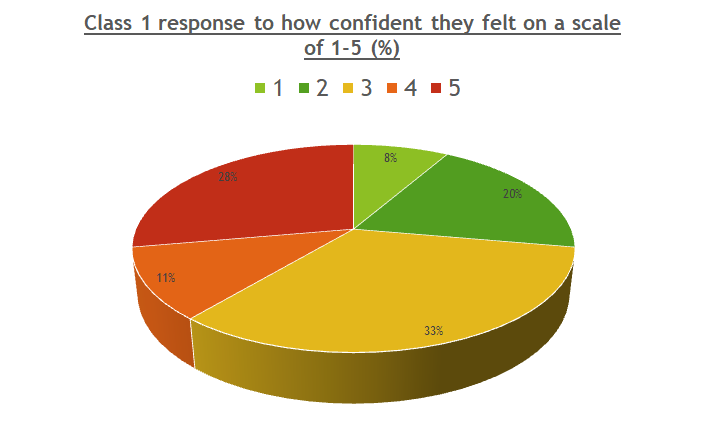
1 = Not confident
5 = Very confident
At the end of the trial I gave a questionnaire to the pupils for them to respond to in order to identify whether or not they had found the resource useful and their confidence in using it. The students response was largely positive. However, a large proportion of the class responded with a neutral or negative answer. Through further discussion I found out that some students saw it as just another task not a resource that promoted thinking or engagement. In addition to this higher ability students reported that they already felt confident in formulating their own questions and the resource became irrelevant. Nevertheless, with the passive students it did provide a way for them to engage in meaningful discussions as it helped the majority of these students in becoming more confident in participating in group discussion. They also reported that they enjoyed the activity and thought it was a fun and engaging exercise.
Further Research:
I feel there is enough evidence to suggest that the use of my question resource can engage learners. I would like to continue to use the question grid in different learning situations and assess the impact on different groups such as passive learners or lower ability students.
Recommendations
Questioning when used effectively can engage passive learners.
Encouraging students to formulate their own questions, using a resource like the one I have used, can encourage meaningful discussion and therefore engagement in a task.
Encouraging students to create their own questions also encourages independence and ownership over a piece of learning.