Our PEPPA teaching and learning model is coming up to its 2nd birthday. You can read the original blog piece launching it here. Recently we have released the PEPPA in action summary guidance - a quick read to remind us all of the excellent pedagogical practices and systems we have at Denbigh that help us deliver the impactful lessons that support our students to 'know more, remember more, do more!' .
Click on the image to see a live version of the guidance with hyperlinks to resources.
What does great teaching and learning look like in action?
PLANNING - We ensure:
our lesson follows the curriculum plan;
our lesson has clear learning objectives and we are sure of the knowledge and skills we intend our students to acquire or rehearse - limiting cognitive overload;
adaptations for students are made based on knowing our students including SEND; giving appropriate stretch and challenge.
knowledge from previous learning and assessment is used to adapt out planning;
our lesson tasks are logically sequenced to ensure longer term memory and recall;
other staff supporting the lesson are informed and prepared for the lesson;
ENGAGEMENT - We ensure:
clear entry routines are planned and followed - meet and greet; distribution of books; do now activities ready on board etc.
behaviour for learning strategies are used effectively to maximise attention such as SLANT and steps to success; and learning modes.
seating plans are implemented;
prior knowledge is engaged; and students are made aware of ‘Why this? Why now?’.
PEDAGOGY - We ensure:
clear explanations and models are used to communicate knowledge and skills;
scaffolds are given when required;
when reading we use effective strategies to ensure students ‘read to learn’;
students are given opportunities to practice and rehearse new knowledge and skills;
we use technology effectively to enhance teaching and learning including the setting of homework.
PROGRESS - We ensure:
questioning and feedback strategies are being used routinely to check the progress of all learners giving opportunities to provide feedback and be adaptive in our teaching (AFL);
we move throughout the classroom when students are engaged in practice to assess progress and provide support;
students are given opportunities to demonstrate mastery of learning through written work or oracy.
Many of the great pedagogical stragies are outlined in your walkthrus book.
No doubt that our the PEPPA in action guidance will evolve as we learn more from educational research and new or rediscovered pedagogical strategies come to light - we are always looking to improve. Nevertheless, as a basis, these core priciples form a narrative for our philosphy of teaching and learning at Denbigh that we aspire to deliver for all.
A good curriculum in a secondary school is an inclusive learning journey on which the student acquires knowledge and skills that prepare them for a successful life after school. It also involves developing or enhancing key attributes to ensure students lead a successful, happy, healthy life and they are actively engaged with the world around them. It sounds simple, yet to achieve this is a complex task... so how should we plan our curriculum? In this blog I'll attempt to provide you with some ideas.
Curriculum Coherency
In Mary Myatt’s book, ‘Huh’ she argues for coherence within curriculum planning through proper identification and teaching of concepts. She points out that these are the golden threads that run through subject's ‘baskets’ which hold meaning and signpost underlying structures. Myatt goes on to say that a well-planned, coherent curriculum, where concepts are revisited in different contexts, helps students to make sense of learning. This also enables them to build on prior learning and understand how it is related to the new knowledge they are acquiring.
Marry Myatt argues that curriculum coherency is crucial to help students develop deep understanding.
Mary Myatt also talks about the 'curse of content coverage' - there is a temptation to think that covering more must mean that students learn more. But I believe that we cannot teach the next lesson or part of the scheme if students have not grasped what we are currently teaching.The idea that we should move on because that is what the schemes of learning says sends the message that the curriculum plan is more important than the students.
Identifying the key concepts
Identifying the key concepts within the curriculum is crucial for learning. The concepts are important because they contain the big ideas and when students grasp these big ideas, learning becomes more efficient. We need to be mindful that if too much curriculum planning is focused on task completion, which is a bad proxy for learning, this may not lead to deep understanding. When students grasp the concepts, their learning is more secure than if they have just completed a few worksheets or exercises from a textbook. Covering a lot of content may give the impression that students have learned a great deal when, in fact, all that may have happened is that students have completed some exercises, the learning is then superficial and will not stay in the long term memory. Students need to be able to say in their own words what they have learnt and how it relates to the bigger picture. If we ensure that the curriculum plans support conceptual development, we make planning easier and learning deeper.
When students understand concepts, this makes new knowledge secure. If students have access to, understand and are able to use the conceptual, technical vocabulary expertly and confidently, they are entering the territory of long term memory. So when we are planning, we have to identify the key concepts we want students to learn. When we identify these and do work around their original meanings, we take students into a deeper understanding of the subject.
Covering content does not guranteed understanding. It is crucial curriculum design provides the flexibility to promote deeper understanding of core concepts.
Thoughtful Sequencing
When the curriculum lacks coherence, it is harder to teach and harder for students to learn. It is tempting to think that because students have been taught something, they have got it. Careful consideration must be paid to the organisation and sequencing of the material to be taught. Topics must be rethought in order to avoid confusion. This needs to be held in mind when long and medium term plans are constructed and also during the daily delivery of lessons. We need to remind ourselves and our students of how what we are learning today fits into a bigger picture.
Knowledge Transfer
I believe that it is important to show students that the learning process is not as isolated as it seems during the school day rather, in reality, it consists of many interconnected pieces. Learning does not end after one timetabled lesson but there are strong links within topics in a subject and across the wider curriculum. Learning is a continuous process not an event.
One way to show students the relevance and interconnectedness of learning is through cross-curricular teaching. Heidi Hayes Jacobs defines cross-curricular teaching as “a conscious effort to apply knowledge, principles, and/or values to more than one academic discipline simultaneously.” The goal of cross-curricular teaching is to bring together seemingly isolated subject areas by incorporating the knowledge and skills of one area into the work done in the others.
One of the benefits of cross-curricular teaching is that the more connections the mind makes, the better it is able to learn and retain information. Cross-curricular teaching helps students make more connections and gives more meaning and relevance to the subjects and skills they are learning. You can at least begin to show students that the things they are learning do have practical applications beyond an isolated classroom.
The more connections students can make between different subjects they learn the more developed there schemas become -this helps to promote deeper understanding and longer term memory and recall.
If we want our students to see and understand the connections between various subject areas, then teachers themselves need to look at each other subject's schemes of learning and identify common topics leading to a discussion on knowledge, skills, pedagogy, similarities and differences and making this explicitly clear to students. Sharing and using the same resources in different subjects allows students to see key concepts in different contexts and having discussions about the different meanings of keywords will lead to less confusion. Doing prior knowledge checks before starting a new unit of work or brainstorming curriculum connections to a new topic with students could lead to an opportunity for teachers from different disciplines to work collaboratively. Leaders need to ensure lesson planning time is used effectively and encourage working collaboratively across the curriculum which will reduce workload in time and forge better working relationships with teachers from different departments.
At Denbigh there are some amazing remote learning practices; Loom videos, Mote feedback, Rubrics in assignments and more. But each of these in isolation does not guarantee that our remote learning is delivering the best results. In this blog post we will look at 6 practices that are common in some of the best remote learning at Denbigh. I am sure it will help you recognise your own good habits and also enable you to reflect on how you can further develop your practice.
1 - The quantity of learning is achievable
Too often one of the barriers to learning is knowledge overload. In a remote learning episode we have to be clear and specific on what we expect our students to learn by the end of it. This also has to be achievable and pose the right level of challenge. Great practice would be to include a small number of key takeaways in our pre-records and keep our videos relatively short especially if what they are learning is new. In last weeks blog the example from Tom Davies demonstrates this well.
Look! Here is a relevant visual metaphor.
2 - The curriculum pace is kept slow
Many of us may be concerned about not covering the content in our curriculums or specifications, because of this we may feel the need to move through the curriculum as quickly as we would do when students are in the classroom. This could be a recipe for disaster. We have probably all noticed that student engagement is not at 100% and that many students are finding it more difficult to learn at home independently. As such, we need to give students more time to consolidate knowledge through regular review and rehearsal. We should build this into our remote learning curriculum. Furthermore, by slowing down the pace, students will feel less overwhelmed, feel secure in the knowledge they are acquiring and ultimately be more confident. Going slow also has the added bonus of giving students who have found it difficult to engage the chance and time to catch up.
"Slow and steady wins the race" said the tortoise to the hare.
Obviously, slowing down the pace of a curriculum is a topic for discussion in subject areas. You could consider how year groups may need to be treated differently. For example a year 9 group starting a GCSE may benefit from going slow now, building a secure knowledge base, and then speeding up later when they come back into school. After all there is no point rushing through a curriculum now (during a lockdown) then in year 11 finding you have to teach it all again because they have forgotten it. In KS3 some subjects may even consider reducing the content in their curriculums to ensure what they do learn - they learn well.
For example Maishah Khan has reduced her Year 9 Psychology curriculum considerably to only teach one key theory this term (only four pages of the GCSE textbook). The first three weeks of term students have engaged in small chunks of new knowledge where understanding was assessed using quizzes and short questions. Then, in the upcoming three weeks students are due to consolidate this knowledge into revision resources, exam style questions and a mini-assessment that finally culminates into an evaluation of the theory.
An overview of the remote learning curriculum in Year 9 Psychology.
3 - Only tasks that effectively support and check learning are set
Many of the tasks that we set in the classroom do not translate effectively to the remote learning digital environment. Let's consider a word search or crossword activity. In the classroom it's a reasonable little starter that can settle students and get them to retrieve some keywords with some good questioning. However, set as a remote learning task it can be a nightmare... lots of emails and comments "how do you fill in the word search? How can I highlight the words? I can't do the word search sir! Help!" All of a sudden you may have a large number of students stuck on a task that at the end of the day is pretty meaningless when it comes to assessing the learning. The task can actually become a barrier to learning.
Do this word search digitally and hand it in to me. Then tell me what you learnt.
We cannot recreate remote lessons as a facsimile of how we delivered them in the classroom, it does not work. The best remote learning ruthlessly cuts tasks that will create barriers to student learning and only sets tasks which will support learning and enable it to be assessed efficiently.
4 - Tasks are modelled effectively
Sometimes the tasks we want students to complete are complex and necessary. If this is the case, we must model them. If a student cannot understand the process of a task, they will not engage and they will feel demotivated. How can you avoid this in a remote learning context? Model tasks to students explicitly through video tutorials - and it MUST be in videos. Students respond far better to practical demonstrations of tasks rather than written instructions (NEWSFLASH - they often don't even read them!). We know that when we are in the classroom live modelling is one of the most effective methods that a teacher employs to support students to engage in a task; we can't just replace this with written instruction and expect the same results.
In MFL the team have been superb in sharing a video for every lesson explaining how to complete tasks along with written instructions. You can also look at this example from Eric Adjei's Year 11 History where he models an essay question in his own unique style that is the only task for completion that lesson.
5 - Regular feedback is given
Doing work and getting no feedback is almost the same as doing no work at all. A lack of feedback and acknowledgement of the work completed is intrinsically de-motivating. As teachers, we need to avoid this by offering feedback as soon as we possibly can. This need not be onerous. With self-marking quizzes, rubrics and now the amazing mote, we have several time-saving ways to give feedback. The video below is an example of how you can use google forms to provide automatic feedback that has been developed in RE. You can also check this post here about the use of rubrics.
Whole class feedback is also a great time saving way to keep students motivated. Take a look at this example from Taslima Hannan in English where she gives some group feedback on a poetry task her year 8's have completed.
6 - The human touch is not lost
The saddest part of the remote learning experience is that the relationship between teacher and students can often be lost. In this lockdown the formulaic, almost robotic like routine of plan lesson, post lesson, mark work and repeat, has removed the humanity from being a teacher. The jokes, the smiles, the equally enjoyable nagging and telling offs, the motivational speeches... all the things that make teaching and learning a fulfilling human experience have disappeared!
Well there are ways to keep the human touch going. Why not send a motivational video of yourself to your classes? Do some positive name dropping and bigging up (the students that aren't mentioned might get the hint). Have a watch of my little pep talk to my year 11s this week and see what you think.
We need to remember that these are extraordinary times and that for many of us it is a difficult time too. We need to show understanding and encouragement.
...
Thanks to all the teachers who have contributed to this week's blog. There will be more examples of good practice coming next week. Leave a comment if you have found this useful or interesting - it'll make my day! 😊
The focus for my research is around Cognitive Load Theory and how using Chromebooks and Google Applications can promote longer term memory and recall by considering the cognitive load on learners.
Literature Review - Cognitive Load Theory
Cognitive Load Theory is based upon an understanding of how information is held in working memory and then processed into the long term memory. There are three types known as intrinsic load, which concerns the difficulty of the task; extraneous load, which is unnecessary thinking required by students, and germane load, which is load required by the teaching task to support the learning.
Research into cognitive load suggests a number of different strategies particularly with the use of teacher presentations. Tharby (2019) suggests that “labels are integrated into diagrams and ensure that information is presented in close physical proximity to related information”. He further mentions the importance of “images to support complex and conceptual idea”, which can help reduce germane load. Tharby (2019) explores a range of different strategies to support effective classroom pedagogy:
Ensure that labels are integrated into diagrams and ensure that the information is presented in close physical proximity to related information.
Avoid reading out text that is already on the slide
Remove distractions or superfluous images
Use images to support complex and conceptual ideas
If you intend to explain an image, it is best not to include written text at the same time.
Never expect students to read something from the board while you are talking
Reveal processes stage by stage on the same slide.
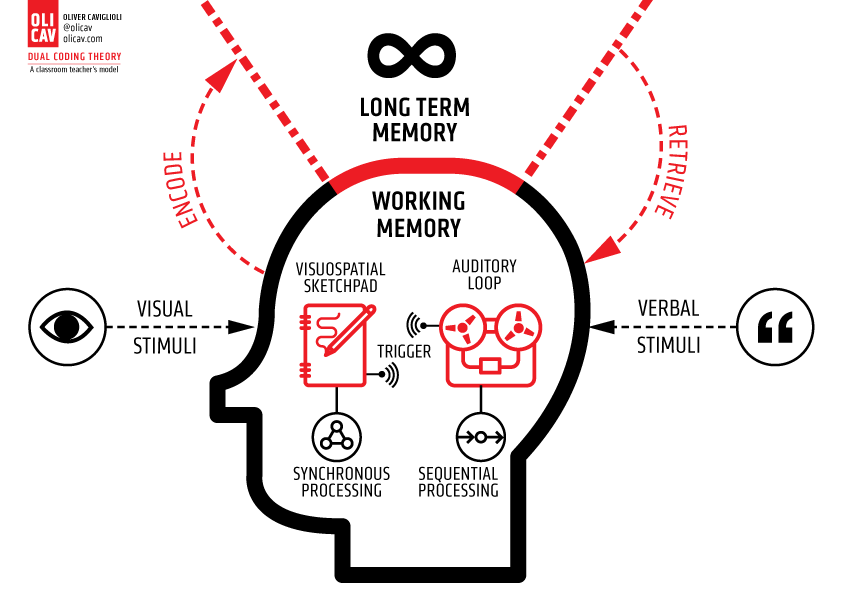
Oliver Caviglioli is a leading figure in applying cognitive load theory to diagrams and presentations (a link to a webinar is included below).
In our Computer Science department we have identified that students struggle with the cognitive load placed upon them due to the quantity of new knowledge that they need to process to be successful at the new GCSE specification. This load often causes students to become stressed, demotivated or both. A solution to this that will form part of my practitioner study is to introduce some of the knowledge required in the GCSE specification at an earlier level to help scaffold the knowledge, reducing load at a later stage. In lessons we should also be able to apply some of the techniques advised by Andy Tharby to support learning. Finally through the use of Chromebooks and the G-suite of educational tools such as Google Classroom we should be able to further reduce the cognitive load on students by building knowledge through routine low stakes assessment and supporting homework tasks.
Intervention
I aim to use my year 8 computer science class (82/Cs) they are a group of mostly high achieving pupils who have already had a number of difficult topics at GCSE computer science introduced in a way which reduces unnecessary difficulties and promotes long-term knowledge retention. Their long-term memory will be tested at regular intervals to check if cognitive load strategies help with completing these tasks.
The intervention will involve using pre-prepared examples, with models, flowcharts and other relevant images to support text (following the guidance of Andy Tharby). There will also be permanent access to task instructions and success criteria available on Google Classroom for the pupils to access. The resources will cover a whole half-term of learning which will deliver new content pupils haven’t been exposed to before on algorithms. The learning will also be supported by Google Form assessments that will be completed using Chromebooks.
Using the Cognitive Load and technology strategies suggested I am hoping to see an improvement in knowledge retention as the reduced cognitive load will ensure greater transfer of knowledge into the long term memory. This will be measured through the end of year exams and compared to other groups in year 8 who are not receiving the intervention.
Implementation
The topic for the term was ‘algorithms’ so I wanted to focus on reducing the intrinsic load of the knowledge, by including useful labels and diagrams to support the learning. This strategy along with using the formatting of bold and underline to help reinforce key pieces of information with pupils. After modelling the knowledge the students would complete a range of interactive tasks including defining, creating and reading a variety of flowcharts applying the knowledge learnt from my explanations.
After completing these activities, I explained to the pupils that their homework and classwork would be focussed around specific knowledge and skills this based upon the lesson content (rather than completing a project log for homework where they reflect on their learning journey). I explained that we would be focussing on exploring algorithms in great depth and how we would use Google Forms for assessment with the aim of promoting mastery.
Impact
The pupils managed to show good improvement from the initial control group, which showed that they managed to grasp difficult topics which typically are taught in Year 9. They made strong progress during the 6 week half-term. They were taught an introduction to computational thinking; exploring the 4 main techniques of computational thinking (as seen above). The presentation and use of supporting images pictured above helped articulate each of the key words and then the exploration activities the pupils undertook in the worksheet allowed them to explore and build a strong cognitive understanding of the topic. Other groups learning about algorithms in the same term struggled possibly due to less attention on key subject terminology and more focus on practical task based tasked which overloaded them cognitively.
The pupils typically are asked to complete a project log each week for homework, and after completing a questionnaire the results showed that 84% said they enjoyed completing the Google Forms assessments on their chromebooks and 63% said it helped them to remember the learning which happened in the lesson. In the following term I interviewed a small group of pupils to ask if they enjoyed the topic and the way the knowledge was presented this term. One pupil said “learning the algorithm theory then applying it to flowgorithm was great”. One pupil stated that “I now understand how processes work by using flowcharts”. I had a few suggestions and one pupil stated that “too much information in the first lesson - I couldn’t remember some of the points”. So I need to restructure the learning in this lesson to ensure that it isn’t overwhelming and presented appropriately.
Further research
It’s important to consider the ability of the learners in the control group and considering they are a high ability group the same strategies may not work with lower ability pupils. There are very few research articles around effective cognitive load strategies using technology so it’s always important to consider how technology is helping learning and avoid distraction from learning as much as possible.
The strategies used with this control group could be used as a wider study with other year groups assessing their understanding of algorithms and with older year groups checking understanding of that topic. How information is presented is essential and whilst textbooks are largely no longer used in education it’s important that pupils see the bigger picture of all concepts learnt in computer science for long-term memory retention.
Recommendations
Focus on key knowledge when introducing new learning, and don’t overcomplicate. The information shouldn’t be overwhelming and the use of images and diagrams will help to structure the information in a way that is accessible for all pupils to make strong progress.
Try to avoid distracting images on teacher presentations which will hinder learning for the pupil - and ensure that you assess understanding of new knowledge through effective assessment.
Allow enough lesson time for pupils to practically explore new knowledge and encourage effective discussions in the classroom around the new learning.