Showing posts with label retrieval practice. Show all posts

Wednesday, 3 March 2021

Thoughts on our return to school - Ian Stonnell

Out of the ashes the phoenix rises.
On Monday we meet our students in the classroom for the first time since December. That's quite a long time ago. Now, it will be easy for us to focus on the negatives when they return. We could conduct an audit of who completed their remote learning and who did not, we could give daunting lectures about the lost learning that has taken place and how we need to catch up as quickly as possible. We could dwell on the doom and gloom and have a wonderfully gloomy time doing it. 

This is not what we should do. 

Instead, we need to resist this understandable desire and remember that the times we are living through are extraordinary. No one can be blamed for the disruption that has taken place, particularly the students, and although some of them may have been lazy, the fact that they were given the opporuntiy to be so, by a global pandemic, is not really their fault - just think how you would have responded to a lockdown when you were thirteen! I know I would have struggled, and that would have been in a world with only 5 TV channels and dial up internet. We also cannot discount the reality that many of our students have had a terrible time during this lockdown and have genuine reasons for struggling to engage.

We must show understanding and forgiveness. 

On March 8th we are starting anew together, what has happened has happened and although it has been tough, we will recover and like a phoenix from the ashes, we will come back stronger.
Use the right language

To start anew we have we have to use the right language. At the moment there is a lot of concerning phrases being bandied about by politicians and 'tsars' with regards to education and, as was so neatly summed up by our inspirational headteacher Donna Neely-Hayes, a lot of this waffle needs to be ignored and filtered out - “our students are not damaged”. 

Instead we should see that our students have been through an experience that will define their childhood and scorch an indelible mark on their identity, where they can rightly be proud of their resilience, discipline and independence. I would argue that these students are not damaged, they have been tempered and made stronger whether they realise this yet or not. Let's reinforce that message by making sure we use the right language on their return and not perpetuate a story of loss that can only serve to damage their well-being, rather lets tell a story of growth.

Below is a table of some of the not so useful language that has been floating around with an equivalent positive language replacement which you can use in your classrooms, note how it encourages growth - credit to @MrAWGordon
Move forward with great teaching

Finally some thoughts on teaching, this is a teaching and learning blog after all. My key message - let's not panic, we have done this before. When we returned in September after the first lockdown, we managed just fine. In fact I seem to remember all of us getting so much better at using technology for learning - it was inspirational. I also know that each department has already spent a lot of time planning for the return particularly with a focus on the curriculum, so we are ready. 

However, as a guide, for those first few lessons on our return the following basics can be adhered to:
  1. Retreive: Start of with a stimulus of what may have been covered over lockdown then assess with some low stakes retrieval and questioing to identify gaps in knowledge on small, key parts of the curriculum.
  2. Re-teach: Once gaps are identified, using direct instruction re-teach topics with an emphasis on the gaps - providing models and scaffolding where necessary.
Regardless of this, for now you should have faith in your ability to be what you already are - amazing teachers. No doubt in the near future we will be doing lots more to improve and get even better at supporting our students, that's just what we do. However, that is for the future, on Monday let's just get back to it.

Ian Stonnell @DenbighCPD

Monday, 14 October 2019

How do we make homework meaningful? - Ian Stonnell

Homework... long has it been the bane of many a teacher's working life - that annoying extra little bit of workload that so often feels like an add-on; something to do because we feel we should be doing it but perhaps not 100% sure why. And then when we set it... oh the battles it can create with those students who just don't get it done! It's understandable when some of us in the profession question the point of setting it at all!

However, this is probably going a bit too far. Instinctively we know there is a benefit to homework (there is), maybe what we need is just some convincing of what the benefit is, as well getting a better idea of what makes homework meaningful. Let's see what the research tells us.

Image result for detention
At it's worse homework can be a barrier to learning.
Homework can make a significant difference to student outcomes
In 2015 research was conducted into the effectiveness of homework as a strategy to to improve performance in maths and science [Fernandez-Alonso et al. 2015]. In short it found homework made a positive difference to outcomes. Below are some further thought provoking findings:
  1. Students who were set regular homework performed better compared to those who only received it occasionally.
  2. Frequency of homework was more important than the amount of time spent on an individual piece of homework.
  3. Students who completed there homework by themselves achieved on average 10% better than those who got help from their parents.
  4. More time spent on homework did not necessarily mean better outcomes.


Image result for homework
If students can't do the homework by themselves progress won't happen.

What makes homework effective?
Dylan William famously stated that 'most homework set is crap'. In Fernandez-Alonso' et al's, study they also acknowledge that a lot of homework set was inefficient and lacking in impact (i.e. overblown and too time consuming). Therefore, if we want the best outcomes from homework we need to consider what makes homework effective and efficient. Based upon Fernadez-Alonso's findings and other research by Vatterott we should think about the following questions when we plan and set homework:
  1. What is the purpose? If it has none, don't set it.
  2. Is it a good use of the time it requires to complete? If it's not, re-think it.
  3. Is it something that students perceive as meaningful? If they don't know its meaning, have we told them?
  4. Is it achievable - can students complete the homework without adult support? If they can't how can we blame them when they don't do it?
If the homework you plan has a positive answer to these questions then most likely it will be a motivational task that will have an impact and completion rates will increase.
Image result for improving results
Carefully considering why we set homework is the clear solution to making it meaningful.
The R&D group - A word from Ash Choudhury and Anna Walczynska 
In our first meeting we discussed the current state of homework practice across the school and acknowledged that whilst there were lots of great strategies taking place there were plenty of areas where things were not ideal. One of the main discussion points was what the main purpose of homework is - Is it about supporting memory and recall, rehearsing skills learnt in lesson, or a means to encouraging independent learning or research?

As a group we considered memory and recall to be the primary purpose, after all, knowledge should be at the core, although independent learning would be a positive side effect of the implementation of any homework strategy. Following our sharing of a range of memory recall strategies practitioners decided to draw on five that they felt could be useful models to base a sequence of homework tasks upon:
  • Over-learning
  • Spaced Repetition
  • Retrieval practice
  • Acquisition before application
  • Interleaving
  • Graphic/knowledge organizers
We will soon be planning and implementing some new homework strategies with these discussions in mind and look forward to letting you know what we find out.

If Denbigh staff have any questions feel free to speak to any member of the R&D group.

Ash and Anna

@ash_achoudhury
@AnnaWalczynska

Useful links:

Monday, 7 October 2019

Cognitive Load Theory and its implications on teaching and learning - Ian Stonnell & Ian Hayden

What is cognitive load theory? It sounds complicated. Well it is and it isn't.

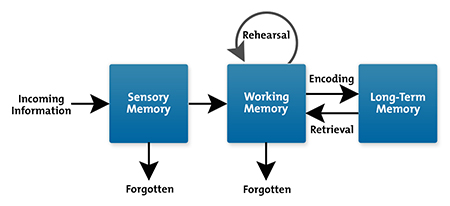
Put in its most simple terms cognitive load theory states that our brains have a limited working memory that can only process small amounts of new information from our environment. If we overload this working memory we are not going to be able to process it and therefore the new information will be forgotten.

Image result for cognitive load theory
A simple model of memory. The working memory is the part that we don't want to overload!

That's a problem for teachers. Today with the expectations of the new curriculum too often we teach at pace, overloading our students, and then wonder why they have forgotten everything we tried to teach them. We've all been there during exam revision when a class genuinely looks back at you with sincere eyes and say, "Sir, we can't ever remember you teaching us that topic". They probably aren't lying to you.

Image result for forgetting memory
If we have overloaded our students working memory chances are nothing was ever learnt in the first place.
However, the implications of cognitive load theory can give teachers a wide variety of strategies to help improve teaching and learning and support long term memory. We discussed two avenues of inquiry - (1) How can we alter the way we present information to minimise cognitive load? (2) How can we aid the retrieval of prior knowledge to aid transferring knowledge into the long term memory?

Willingham's simple model of the mind.

General strategies could be:
  1. When starting new concepts teach slow, accelerate later. 
  2. Consider the knowledge you want students to remember in each learning episode.
  3. Use explanation strategies that avoid overloading working memory and encourage connections with prior knowledge.
  4. Tie any new learning to knowledge already in the long term memory.
  5. Integrate retrieval practice strategies routinely into lessons to enhance student access to knowledge stored in the long term memory.
In our research group we discussed several specific strategies underpinned by cognitive load theory including:
  1. The take home strategy (as demonstrated by Adam Boxer).
  2. Knowledge organisers
  3. Interleaving and spacing
  4. Routine low stakes retrieval practice (including homework)
  5. Explanation strategies e.g. dual coding/direct instruction/worked examples.
Off course cognitive load theory is a lot more complex than how I have presented it here, however, I don't want to overload you with too much unnecessary information! If you want to know more about cognitive load theory and any of the other strategies feel free to peruse some of the links below or search for yourself!

Cognitive load theory and applications:
Knowledge organisers:
Dual Coding:
Retrieval practice:
Explanation techniques (based on understanding of CLT):
Interleaving and spacing:

Hope you find this helpful!

Ian Stonnell @DenbighCPD
Ian Hayden @IanHayden8