Showing posts with label Knowledge. Show all posts

Wednesday, 20 January 2021

Remote Learning in Practice - Tom Davies - Production Studies

In this week's blog take a look at this superb pre-recorded video lesson from Tom Davies in year 8  production studies. Once you've had a watch have a read of some of the key takeaways and considerations and see if you agree. 

Thanks to Tom for being a top level legend for sharing! 💪

Key Takeaways:

  • In this example there are clear expectations of the desired learning outcomes including the process of how the students can meet them.
  • Students are encouraged to review previous learning before engaging in new learning.
  • Task modelling - the task is clearly modelled and scaffolded giving students the best chance of completing the final task well. 
  • The use of 'PAUSE, REPEAT, REVISE' - what a great practice that we could all add to our pre-recorded lessons!

Feel free to copy and paste this image into your pre-recorded lessons.

Further considerations for all based upon this example:
  • Avoid overload - particularly the setting of extraneous tasks. The requirement for note taking in this example is an extraneous task as it does not add to the learning, it just adds a process. The only task that really matters is the final worksheet where valid assessment can take place - as such, in this remote learning environment it may be better to remove the note taking element. We should all consider what tasks we may be asking students to complete that are actually not really contributing to learning and consider removing them. 
  • Streamline the quantity of new knowledge delivered. In this example both celebrity endorsements and shocking images are discussed. It may be wise to consider focusing only on one area to avoid overload and maximise the chances of longer term memory and recall.

Ian Stonnell @DenbighCPD

Thursday, 2 April 2020

CPD in the time of Covid-19 - Subject Knowledge - Ian Stonnell

Subject knowledge has for many years been a neglected aspect of teacher development. Thinking back to when I was an NQT, the main focus of CPD was on pedagogy, classroom practice and the pastoral aspects of the job - subject knowledge sessions were sporadic and came occasionally through an external CPD course.

I suppose the logic behind this is based upon a presumption that a teacher already possesses the subject knowledge they require to teach, after all they should have a degree and a passion in that subject (why else would you want to teach it?) There is also a presumption that any gaps in teacher knowledge would be easily filled on the job. So long as we stayed a page ahead in the textbook, after a few years a teacher's knowledge would be secured.

However, this approach is increasingly up for debate. To understand the debate it is useful to understand the three types of knowledge teachers require to be effective.
  1. Subject knowledge: Knowledge of a domain. e.g. Maths or Art etc.
  2. Pedagogical knowledge: Knowledge of how to teach e.g. adaptive learning, cognitive science, metacognition, SEND, behaviour management etc.
  3. Pedagogical content knowledge: Knowledge of how to teach a given subject. e.g. how to run a tennis skills session in PE or a short skit in drama.
The best teachers are competent in all three areas. However, currently subject knowledge is neglected in our CPD models. The current trend says this needs to change.
Currently CPD in most schools does not take into account subject knowledge development.
How important is subject knowledge?
With the changes in GCSE specification to be 'knowledge rich' there has been a scramble for teachers to fill the gaps. However, although many may have complained about this upscaling in knowledge, it is important to understand why this change has happened.

Think about money. There is a well known principle that if we start off our lives with a large amount of capital then it is easier to create more capital, regardless of how 'talented' we may be. Also if we have very little capital it is incredibly difficult to make any. Thus a gap between rich and poor develops. This is known as the Matthew effect.


Small Loan of a Million Dollars - Donald Trump CNN - YouTube
Donald Trump may not be the most talented person around but with a small starting loan of a million dollars from his Dad he managed to do okay!

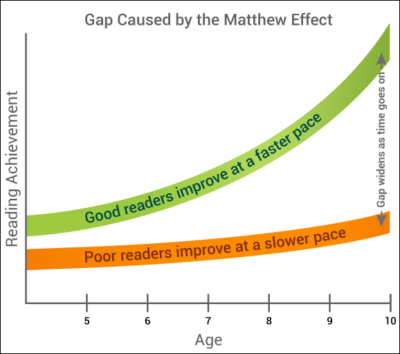
The Matthew effect also applies to knowledge. The more we know about a specific area of knowledge the easier it is to acquire more knowledge in that area. For our pupils, who are novices, acquiring knowledge is crucial in enabling them to accelerate and acquire more knowledge. As such, the knowledge rich curriculum is an attempt to narrow the gap between disadvantaged students and the rest. 

Research has shown that there is 'Matthew effect' in reading which has led to a word gap between advantaged and disadvantaged students.
This means that teachers need to be secure in the subject knowledge themselves in order to be able to deliver it effectively using sound pedagogical practices. This knowledge also needs to be deep enough to engage students. This is evident in many student surveys that have taken place at Denbigh in which students rate the best teaching in line with the teachers who they perceive to have the best subject knowledge. Furthermore, the students who won scholarships to Berkhamsted Sixth Form College reported that one of the major differences they noted was the subject expertise that their teachers possessed (this could be accounted for due to the transition to sixth form). 


It is evident that some of the most appreciated teachers are the ones who have deep subject knowledge. 


As an RE teacher, I can confess that my ability as a teacher only improved with the development of my own subject knowledge. Take for example my own knowledge of Islam. In my NQT year, a decade ago, my knowledge was no deeper than the five pillars. I could make a fun lesson or two and design lots of activities around them but the deeper knowledge behind those five pillars, the links to Islamic beliefs, history and culture and how they relate to personal and spiritual development did not exist. 

The best piece of CPD I did was to develop my knowledge of Islam. I sought out books on Islamic history and the Sunni/Shiah split, biographies of the Prophet (pbuh), as well as watching every documentary I could find. It took many years and is still ongoing.

Two of the books that helped me to become a better teacher of Islam.
Now, I would not claim to be anywhere near an expert (as the more we know, the more we realise we don't know) but I can be confident in answering further questions and contextualising beliefs and practices with a few more interesting anecdotes that promote engagement. That makes me a better teacher of RE regardless of what students I teach. 


How do we develop subject knowledge? 

Pedagogy matters - CPD in schools aims to help develop it and it should continue to do so. However subject knowledge needs more time. As a CPD lead at Denbigh we are planning to give more time to departments to help develop it in the upcoming 2021-22 academic year. Nevertheless, the best way to do it is to be passionate about our own subjects and seek out books, websites, subject associations and documentaries to develop our knowledge of our subjects (whether it be knowledge of the content we teach, or wider knowledge of that subject). 

28% of Americans Have Not Read a Book in the Past Year | Time
"The more that you read, the more things you will know. The more that you learn, the more places you'll go" Dr Seuss. You can also add to the end of this quote - "and the more you can teach".
Enjoy your reading!


Further Reading

Wednesday, 20 November 2019

Engaging Passive Learners in Mathematics - Muhammad Haroon

Research and development focus
Every teacher, regardless of experience, has come across a passive learner during their teaching career. The issue with passive learners is that they are rarely disruptive. This means they often go unnoticed and unchallenged. This lack of challenge results in poor progress and ultimately a child who is let down. Therefore, my main focus is to research different techniques which can be used to encourage passive learners to be more involved during lesson time, this in turn can increase student achievement. Research shows (and common sense implies) that there is a clear positive correlation between these two variables.
Image result for passive students
Passive learners often go unnoticed and unchallenged.
Literature Review
Engaging students is the clear antidote to passivity. According to Meier (2008), one way of engaging students is by making learning relevant to them by connecting it to a student's life experience. Getting students to solve authentic real life problems based upon experience, such as working out phone bills, can support them beyond the four walls of a classroom and give a subject value, thus engaging them. It was also discovered that students found it easier to solve problems and remember the techniques used when they were connected to life experiences thanks to links to prior knowledge the students already possess.

Another way to increase engagement is by getting students to collaborate with each other, either in pairs or in small groups as this also allows students to share and build their ideas and make themselves feel included and responsible for their own learning. Lastly, getting students to develop and use their higher order thinking skills such as analyzing, interpreting, and/or manipulating information has shown to improve engagement as a form of challenge. The key issue however, is how we can implement these strategies effectively.

Image result for manchester metropolitan RME

Intervention
The Realistic Maths Education (RME) project is a resource which has taken over 14 years to research and design by academics at Manchester Metropolitan University. I have been given several resources over a span of two years to help improve the teaching of mathematics from this project. Each module is designed to be completed over two weeks.

I will be using RME strategies with my two year 7 classes and monitor two passive learners from both of them. These students tend to lose focus or interest very quickly and I have to continuously remind them to either focus on what I am teaching or on completing their work.

Having attended the training days, I learnt different strategies for engaging students. I intend to use these techniques such as getting students to draw their solutions to problems onto the class whiteboard and hand over a degree of ownership of the work as well as setting problems that relate to their prior knowledge. The resources used in the lessons have been shown in other contexts to engage and therefore reduce passive learners and so improve the students results as well as their problem solving mathematical skills.

I intend to keep track of the passive students and take note of any passive or engaged behaviours shown during the lessons in which I use the RME strategies as well as ask their perceptions of the strategies.

Image result for student at whiteboard
Encouraging students to own sections of learning by writing answers on a class whiteboard can engage learners.
Implementation and Impact
After planning and delivering the first session of the RME project, there was some improvements as the students were more engaged when I gave them a responsibility during a group discussion or when I gave them ownership of their work when presenting to the class. However, unless it was one of those two scenarios, the students were still passive during the lessons. When I asked the students how they were finding the strategies their responses were unresponsive and they claimed that they would rather do book-work. This was expected as we were told this was a common initial reaction from the students as it is a big change on how the style of teaching and learning.

When I taught the second module, one of the students was given a red, amber and green card. They were asked to show me one of the cards depending on how engaged they felt during the lesson. During my two period 5 lessons (end of the day), the student always showed an orange or red card which indicated that he was going to do some work or very little work. For this reason I was unable to see any impact of the RME strategies during these lessons. However, during the other two lessons, the student was very engaged and preferred taking part in the RME strategies instead of doing a standard book-work lesson. I did a short interview with the student in which they stated that they enjoyed the lessons more as they saw the relevance of the topics covered during these lessons. However, it is a concern that the uncontrollable variable of the time of the lesson counteracted the positive effects of the RME strategies.

Other students also showed some limited improvement. They were more interested and focused during certain activities however for much of the lesson the student still demonstrated passive behaviour and regular prompts had to be used during the lesson to keep them focused. I have completed several modules with this student but I am still going to continue to use the RME modules with other techniques to see if the student can become further engaged.

Image result for teaching
The holy grail of a fully engaged classroom can be achieved!
In conclusion, so far the students have made some progress but there is still a lot of room for further sustained development to be made. The problem is that there are many reasons as to why a student might be passive. Some students have fixed mindsets of their ability in maths, others are yet to see value in the subject, whilst other students may have other unknown reasons that extend beyond the classroom affecting their ability to become engaged. Nevertheless, the RME project has had an initial impact on the students and as such I will continue to use this resource to create a sustained culture change in teaching and learning. However other whole school strategies such as linking maths to career pathways and future aspirations could be applied to motivate and combat passivity as a separate approach to this complex issue.

Further research
I intend to continue using this resource with the students in year 8 and continue monitoring how the modules can help engage and reduce passive learners in the classroom over a longer period of time. My research will go on to support a wider project led by academics at Manchester Metropolitan University.

Recommendations
  • Be persistent when implementing new strategies, at first they may not work but over time they can lead to a change in culture and help achieve marginal gains.
  • Link learning and problem solving to other areas were students may have prior knowledge - this can be from previous learning or from their life experiences. 
  • Present students with an opportunity to own sections of their learning.
References and further reading
Muhammad Haroon - Teacher of Maths

You can follow Muhammad on twitter:

@MHaroon54


Thursday, 7 November 2019

The Assessment Revolution - Ian Stonnell

Assessment is one of the most complex activities a teacher can get involved in. What seems a simple enough task of checking how well a student is doing can quickly become a minefield. Take for example the old model of assessment. Once we had levels and flight paths - students who came to us in year 7 were expected to make three levels of progress by year 9 (I think that's how I remember it). Seems simple enough until we actually began to sit down and work out what any of these levels meant; 'Is this work a level 4....? Maybe, but if it is a level 4, is it a level 4a, 4b or 4c?' 'Hang on a minute does this fit in with what a level 4b is nationally?' 'What's the criteria again...?' (I remember this being rather woolly and subjective in RE).

I am sure many of us remember having these entirely heartfelt, but basically empty conversations about placing students into these abstract levels - it felt more like a charade to please an accountability machine, which in essence it was.
An old school flight path that looks pretty but may not be that useful in supporting progress.
Back then, were we as teachers really thinking about the important things such as what the students actually knew and what they could do? Maybe not as much as we should have.

Ultimately, should we as teachers really care what abstract level or grade a student is? Shouldn't a teacher's main concern be about what students know and can do? Surely, if we worry about that, any level or grade that needs to be assigned by the accountability machine (exam boards et. al) will look after themselves.

The assessment revolution
In 2015 there was a big rethink in assessment:

“In the context of curriculum freedoms and increasing autonomy for schools, it would make no sense to prescribe any one model for assessment. Curriculum and assessment are inextricably linked. Schools should be free to develop an approach to assessment which aligns with their curriculum and works for their pupils and staff” - Commission on Assessment Without Levels, 2015.

The old KS3 levels were abolished and responsibility for developing assessment policies were handed over to schools. This posed an opportunity and challenge to make new assessment systems that are more meaningful to teachers and students and remove some of the failings of the past.

Image result for life after levels

Life after Levels
At Denbigh subject leaders developed KPIs (key progress indicators) to identify specific pieces of knowledge and skill that can pin-point student progress. The logic being that these KPIs should link directly to the curriculum that subjects are teaching. In the light of the knowledge rich curriculum an emphasis upon knowledge could also be placed and in any assessment, summative or formative, a teacher can gather evidence for the relevant KPIs they are testing for.

In this context subjects have been liberated and assessment conversations can become more meaningful, devoid of an abstract level.

However the implementation of such systems is key. Are the KPIs relevant to the curriculum? Are they accessible to students? Can they be easily assessed or are they themselves too abstract? And do they actually support pupil progress? - They can't just be a new summative system that tells a student what they don't know or can't do and leave it at that - they have to help make them better.


Image result for teachers questioning students

Teachers and Formative Assessment
Teachers must understand that assessment is continuous and fluid. Assessment should form a dialogue between teacher and pupil with the aim to improve pupils’ understanding, learning and raise achievement. Utilising well thought out KPIs, assessment should be motivating and meaningful for both teacher and learner - teachers will glean information about pupil performance and use this to inform planning and progression for individuals and groups, whilst pupils will have an acute awareness of what they need to do improve but more importantly, how to improve and understand the importance of that progression.

Aims of the R&D group - Jess Pather and Samantha Lewis
In this research and development group we are looking at ways we can make the new assessment policy work at Denbigh. We also aim to discover and share the best innovative practice that is currently happening in formative assessment and find out if it works in developing student motivation and the development of their longer term memory and recall.

Below are some useful links to some further reading on assessment as well as some general evidence based formative assessment strategies you can try.

You can follow Jess Pather and Samantha Lewis on Twitter:

@jpather74
@MrsSLewis1

Useful links:
https://teacherhead.com/2019/01/10/revisiting-dylan-wiliams-five-brilliant-formative-assessment-strategies/
https://cambridge-community.org.uk/professional-development/gswafl/index.html
https://learningspy.co.uk/category/assessment/
https://teacherhead.com/2017/12/18/fiveways-of-giving-effective-feedback-as-actions/
http://www.sec-ed.co.uk/best-practice/assessment-developing-your-own-approach/
https://www.youtube.com/watch?v=qLpAalDaqQY

Monday, 14 October 2019

How do we make homework meaningful? - Ian Stonnell

Homework... long has it been the bane of many a teacher's working life - that annoying extra little bit of workload that so often feels like an add-on; something to do because we feel we should be doing it but perhaps not 100% sure why. And then when we set it... oh the battles it can create with those students who just don't get it done! It's understandable when some of us in the profession question the point of setting it at all!

However, this is probably going a bit too far. Instinctively we know there is a benefit to homework (there is), maybe what we need is just some convincing of what the benefit is, as well getting a better idea of what makes homework meaningful. Let's see what the research tells us.

Image result for detention
At it's worse homework can be a barrier to learning.
Homework can make a significant difference to student outcomes
In 2015 research was conducted into the effectiveness of homework as a strategy to to improve performance in maths and science [Fernandez-Alonso et al. 2015]. In short it found homework made a positive difference to outcomes. Below are some further thought provoking findings:
  1. Students who were set regular homework performed better compared to those who only received it occasionally.
  2. Frequency of homework was more important than the amount of time spent on an individual piece of homework.
  3. Students who completed there homework by themselves achieved on average 10% better than those who got help from their parents.
  4. More time spent on homework did not necessarily mean better outcomes.


Image result for homework
If students can't do the homework by themselves progress won't happen.

What makes homework effective?
Dylan William famously stated that 'most homework set is crap'. In Fernandez-Alonso' et al's, study they also acknowledge that a lot of homework set was inefficient and lacking in impact (i.e. overblown and too time consuming). Therefore, if we want the best outcomes from homework we need to consider what makes homework effective and efficient. Based upon Fernadez-Alonso's findings and other research by Vatterott we should think about the following questions when we plan and set homework:
  1. What is the purpose? If it has none, don't set it.
  2. Is it a good use of the time it requires to complete? If it's not, re-think it.
  3. Is it something that students perceive as meaningful? If they don't know its meaning, have we told them?
  4. Is it achievable - can students complete the homework without adult support? If they can't how can we blame them when they don't do it?
If the homework you plan has a positive answer to these questions then most likely it will be a motivational task that will have an impact and completion rates will increase.
Image result for improving results
Carefully considering why we set homework is the clear solution to making it meaningful.
The R&D group - A word from Ash Choudhury and Anna Walczynska 
In our first meeting we discussed the current state of homework practice across the school and acknowledged that whilst there were lots of great strategies taking place there were plenty of areas where things were not ideal. One of the main discussion points was what the main purpose of homework is - Is it about supporting memory and recall, rehearsing skills learnt in lesson, or a means to encouraging independent learning or research?

As a group we considered memory and recall to be the primary purpose, after all, knowledge should be at the core, although independent learning would be a positive side effect of the implementation of any homework strategy. Following our sharing of a range of memory recall strategies practitioners decided to draw on five that they felt could be useful models to base a sequence of homework tasks upon:
  • Over-learning
  • Spaced Repetition
  • Retrieval practice
  • Acquisition before application
  • Interleaving
  • Graphic/knowledge organizers
We will soon be planning and implementing some new homework strategies with these discussions in mind and look forward to letting you know what we find out.

If Denbigh staff have any questions feel free to speak to any member of the R&D group.

Ash and Anna

@ash_achoudhury
@AnnaWalczynska

Useful links:

Wednesday, 25 September 2019

Knowledge at the core - Adam Boxer

Dear Denbigh staff,

I hope you all were inspired by Adam's session last night. Adam originally delivered this talk at the Festival of Education in 2018 and has written a blog post that provides a summary. Click the link below to go to the blog post directly.

https://achemicalorthodoxy.wordpress.com/2018/06/21/knowledge-at-the-core-how-to-live-an-enriched-life/

There is also a lot of other great resources and ideas to feast upon if you delve further into his blog - A Chemical Orthodoxy - Schools, Science and Education


Image result for knowledge


He has been a regular contributor to ResearchED which I cannot recommend to you enough. You can check out by clicking on the picture below as well as the CogSciSci blog recommended by Adam.
Image result for researched
Image result for cogscisci

You can follow Adam Boxer on twitter @adamboxer1

If you want to read more about the knowledge in the curriculum you can visit this blog from the Chartered College of Teaching (subscription required) as well as these other free blogs as starting points:
Have a great day!

Ian