Showing posts with label Cognitive load theory. Show all posts

Thursday, 28 January 2021

Remote Learning - 6 Practices that make it succeed at Denbigh - Ian Stonnell

At Denbigh there are some amazing remote learning practices; Loom videos, Mote feedback, Rubrics in assignments and more. But each of these in isolation does not guarantee that our remote learning is delivering the best results. In this blog post we will look at 6 practices that are common in some of the best remote learning at Denbigh. I am sure it will help you recognise your own good habits and also enable you to reflect on how you can further develop your practice. 

1 - The quantity of learning is achievable
Too often one of the barriers to learning is knowledge overload. In a remote learning episode we have to be clear and specific on what we expect our students to learn by the end of it. This also has to be achievable and pose the right level of challenge. Great practice would be to include a small number of key takeaways in our pre-records and keep our videos relatively short especially if what they are learning is new. In last weeks blog the example from Tom Davies demonstrates this well.
Look! Here is a relevant visual metaphor.
2 - The curriculum pace is kept slow
Many of us may be concerned about not covering the content in our curriculums or specifications, because of this we may feel the need to move through the curriculum as quickly as we would do when students are in the classroom. This could be a recipe for disaster. We have probably all noticed that student engagement is not at 100% and that many students are finding it more difficult to learn at home independently. As such, we need to give students more time to consolidate knowledge through regular review and rehearsal. We should build this into our remote learning curriculum. Furthermore, by slowing down the pace, students will feel less overwhelmed, feel secure in the knowledge they are acquiring and ultimately be more confident. Going slow also has the added bonus of giving students who have found it difficult to engage the chance and time to catch up. 
"Slow and steady wins the race" said the tortoise to the hare.
Obviously, slowing down the pace of a curriculum is a topic for discussion in subject areas. You could consider how year groups may need to be treated differently. For example a year 9 group starting a GCSE may benefit from going slow now, building a secure knowledge base, and then speeding up later when they come back into school. After all there is no point rushing through a curriculum now (during a lockdown) then in year 11 finding you have to teach it all again because they have forgotten it. In KS3 some subjects may even consider reducing the content in their curriculums to ensure what they do learn - they learn well.

For example Maishah Khan has reduced her Year 9 Psychology curriculum considerably to only teach one key theory this term (only four pages of the GCSE textbook). The first three weeks of term students have engaged in small chunks of new knowledge where understanding was assessed using quizzes and short questions. Then, in the upcoming three weeks students are due to consolidate this knowledge into revision resources, exam style questions and a mini-assessment that finally culminates into an evaluation of the theory.

An overview of the remote learning curriculum in Year 9 Psychology.
3 - Only tasks that effectively support and check learning are set
Many of the tasks that we set in the classroom do not translate effectively to the remote learning digital environment. Let's consider a word search or crossword activity. In the classroom it's a reasonable little starter that can settle students and get them to retrieve some keywords with some good questioning. However, set as a remote learning task it can be a nightmare... lots of emails and comments "how do you fill in the word search? How can I highlight the words? I can't do the word search sir! Help!" All of a sudden you may have a large number of students stuck on a task that at the end of the day is pretty meaningless when it comes to assessing the learning. The task can actually become a barrier to learning.
Do this word search digitally and hand it in to me. Then tell me what you learnt.
We cannot recreate remote lessons as a facsimile of how we delivered them in the classroom, it does not work. The best remote learning ruthlessly cuts tasks that will create barriers to student learning and only sets tasks which will support learning and enable it to be assessed efficiently.  

4 - Tasks are modelled effectively
Sometimes the tasks we want students to complete are complex and necessary. If this is the case, we must model them. If a student cannot understand the process of a task, they will not engage and they will feel demotivated. How can you avoid this in a remote learning context? Model tasks to students explicitly through video tutorials - and it MUST be in videos. Students respond far better to practical demonstrations of tasks rather than written instructions (NEWSFLASH - they often don't even read them!). We know that when we are in the classroom live modelling is one of the most effective methods that a teacher employs to support students to engage in a task; we can't just replace this with written instruction and expect the same results. 

In MFL the team have been superb in sharing a video for every lesson explaining how to complete tasks along with written instructions. You can also look at this example from Eric Adjei's Year 11 History where he models an essay question in his own unique style that is the only task for completion that lesson.


5 - Regular feedback is given
Doing work and getting no feedback is almost the same as doing no work at all. A lack of feedback and acknowledgement of the work completed is intrinsically de-motivating. As teachers, we need to avoid this by offering feedback as soon as we possibly can. This need not be onerous. With self-marking quizzes, rubrics and now the amazing mote, we have several time-saving ways to give feedback. The video below is an example of how you can use google forms to provide automatic feedback that has been developed in RE. You can also check this post here about the use of rubrics.


Whole class feedback is also a great time saving way to keep students motivated. Take a look at this example from Taslima Hannan in English where she gives some group feedback on a poetry task her year 8's have completed.


6 - The human touch is not lost
The saddest part of the remote learning experience is that the relationship between teacher and students can often be lost. In this lockdown the formulaic, almost robotic like routine of plan lesson, post lesson, mark work and repeat, has removed the humanity from being a teacher. The jokes, the smiles, the equally enjoyable nagging and telling offs, the motivational speeches... all the things that make teaching and learning a fulfilling human experience have disappeared! 

Well there are ways to keep the human touch going. Why not send a motivational video of yourself to your classes? Do some positive name dropping and bigging up (the students that aren't mentioned might get the hint). Have a watch of my little pep talk to my year 11s this week and see what you think.


We need to remember that these are extraordinary times and that for many of us it is a difficult time too. We need to show understanding and encouragement. 

...

Thanks to all the teachers who have contributed to this week's blog. There will be more examples of good practice coming next week. Leave a comment if you have found this useful or interesting - it'll make my day! ðŸ˜Š

Ian Stonnell @DenbighCPD

Wednesday, 20 January 2021

Remote Learning in Practice - Tom Davies - Production Studies

In this week's blog take a look at this superb pre-recorded video lesson from Tom Davies in year 8  production studies. Once you've had a watch have a read of some of the key takeaways and considerations and see if you agree. 

Thanks to Tom for being a top level legend for sharing! 💪

Key Takeaways:

  • In this example there are clear expectations of the desired learning outcomes including the process of how the students can meet them.
  • Students are encouraged to review previous learning before engaging in new learning.
  • Task modelling - the task is clearly modelled and scaffolded giving students the best chance of completing the final task well. 
  • The use of 'PAUSE, REPEAT, REVISE' - what a great practice that we could all add to our pre-recorded lessons!

Feel free to copy and paste this image into your pre-recorded lessons.

Further considerations for all based upon this example:
  • Avoid overload - particularly the setting of extraneous tasks. The requirement for note taking in this example is an extraneous task as it does not add to the learning, it just adds a process. The only task that really matters is the final worksheet where valid assessment can take place - as such, in this remote learning environment it may be better to remove the note taking element. We should all consider what tasks we may be asking students to complete that are actually not really contributing to learning and consider removing them. 
  • Streamline the quantity of new knowledge delivered. In this example both celebrity endorsements and shocking images are discussed. It may be wise to consider focusing only on one area to avoid overload and maximise the chances of longer term memory and recall.

Ian Stonnell @DenbighCPD

Tuesday, 5 May 2020

CELPO - What does it mean to be engaged? Ian Stonnell

Engagement means to be involved. Now at Denbigh, as I am sure many schools across the land have found, getting students engaged in learning can be a challenge. We have called thus problem 'passive learning' and have been trying to tackle it, as we teachers inherently know that the more engaged students are the better their outcomes will be. However teachers, experienced and otherwise, have often found this a challenge and this is often rooted in misconceptions about what engagement in the classroom actually is.
Engaged Students Clipart
Although it may look students are engaged, are they actually learning anything?
The illusion of engagement
A student actively involved in a task (see image above) is no guarantee of learning. One of the common errors of an inexperienced teacher is believing that students actively doing something in class makes a lesson successful. After all, students are not being disruptive or passive! This kind of lesson could involve sorting cards, producing posters/leaflets or answering questions from a textbook.
The teacher may feel that as long as something is happening and that they are in control, the lesson could be judged as a success. Unfortunately, although control is positive, it is no guarantee that any learning is taking place.

Rob Coe noticed this in his research where he found several poor proxies for learning, including engagement.
Screen Shot 2015-03-31 at 20.14.37
In addition Tom Loveless noticed, when comparing international PISA figures,  that although students in the US were more motivated and engaged in maths compared to those in Singapore, the attainment of students in Singapore was significantly higher. Loveless noted that “the least-confident Singaporean eighth grader still outscores the most-confident American, 551 to 541 [in Maths].” This may reflect cultural differences nevertheless the point is clear - having motivated, busy, and confident learners does not mean they are going to learn as well as they could. A more detailed discussion of this evidence can be found on David Didau's blog here.

The findings of Coe and Loveless caused many a teachers feathers to be ruffled - surely if you have motivated and engaged learners in a well ordered and controlled classroom learning will be brilliant!!!?? Well, no.

Take for example the task of designing a leaflet on a branch of relevant subject knowledge. No doubt you can set this task and a class will be engaged, motivated to complete it, and whilst they are doing it they can be focussed and minimally distracted. Surely, a success? Not really. In reality much of the cognitive load of this task will be spent on what the leaflet looks like, how the paper is folded, the quality of the bubble writing, and the appropriate pictures to draw on it. Very little thought will be placed on the actual knowledge contained within the leaflet, and even if text is included, is any of the knowledge processed and understood, or is it just an inferior copy of something they have found from a textbook? Overall, even if some thinking has occurred, the task of designing a leaflet can be a huge waste of time with very little learning taking place, unless of course you're trying to teach them leaflet design!

In an activity like this engagement in the task is not learning. What we need is students to be engaged in the knowledge we want them to recall - that is true engagement - what I would call engagement in learning.

Ways to fold a leaflet
brochure folding
When making a leaflet a lot of the thinking time is wasted on processes that are not focussed on the knowledge we want them to learn.

What does being engaged in learning look like?
Engagement in learning is good when students are processing the knowledge you want them to learn not the details of a task. This can be seen when students are:
  • Paying attention - students listen to and track the teacher during explanations or modelling of subject knowledge.
  • Asking questions - students have the confidence to ask questions about the knowledge they are being presented.
  • Responding to questions.
  • Students discussing knowledge with their peers.
  • Completing processing tasks with minimal distractions. 
  • Students recalling knowledge and communicating it to others.
Planning for engagement in learning
This is all fair and dandy, but getting a class to this level is not an easy task. Here are a few pointers:
  1. Set the right level of challenge. This will help to ensure students feel like any effort they may spend in a lesson is worthwhile. 
  2. Ensure any planned tasks are linked clearly to the learning objectives and scaffolded appropriately. If a task does not progress the learning, then it is not worth doing and if a task is more complex than the learning point you are trying to make - resist doing it - think of cognitive load theory.
  3. Build knowledge using memory and recall strategies - when students feel they are learning and recalling knowledge their confidence and engagement in learning will grow.
  4. Build positive relationships - perhaps a little too obvious to mention but crucially important - make sure you encourage students, provide them a purpose for learning, and support the development of a growth mindset. 
I could add 'make the knowledge exciting'. However, not all of the knowledge we are tasked to teach students lends itself to being exciting. Obviously, where we can do this we should aim to do so, but it certainly should not be an expected pre-requisite of effective learning.

Do students always need to be engaged to be successful?
Firstly, there is the simple fact that it is just not physically or mentally possible to be engaged 100% of the time in any learning experience, therefore we should not crucify ourselves if students are passive every once in a while. Also, as this blog has argued, students do not have to always be engaged in completing a task to be learning effectively. If a student is sitting in silence and thinking about knowledge (appearing passive) they are still involved in a highly valuable learning process.

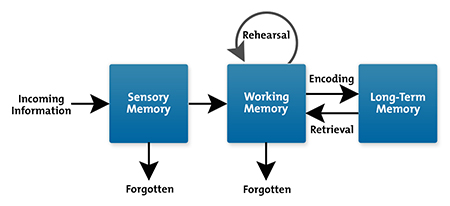
Information Processing/Multi Store Model of Memory | Information ...
The key point of any learning experience is for students to process the knowledge you want them to learn, ultimately encoding it into the long term memory.
Conclusion
What really matters is whether the students have a consistent and persistent diet of opportunities to engage in processing knowledge effectively. If this is the case then knowledge is more likely to stick and learning will take place. Evidence of this will be shown by what any student can tell you about what they have learned in a particular subject - not what they have done. If they can do this, then they have obviously been engaged in their learning! Planning a lesson of engaging and fun activities that will keep students busy will not do.

Ian Stonnell @DenbighCPD

Further Reading

Monday, 7 October 2019

Cognitive Load Theory and its implications on teaching and learning - Ian Stonnell & Ian Hayden

What is cognitive load theory? It sounds complicated. Well it is and it isn't.

Put in its most simple terms cognitive load theory states that our brains have a limited working memory that can only process small amounts of new information from our environment. If we overload this working memory we are not going to be able to process it and therefore the new information will be forgotten.

Image result for cognitive load theory
A simple model of memory. The working memory is the part that we don't want to overload!

That's a problem for teachers. Today with the expectations of the new curriculum too often we teach at pace, overloading our students, and then wonder why they have forgotten everything we tried to teach them. We've all been there during exam revision when a class genuinely looks back at you with sincere eyes and say, "Sir, we can't ever remember you teaching us that topic". They probably aren't lying to you.

Image result for forgetting memory
If we have overloaded our students working memory chances are nothing was ever learnt in the first place.
However, the implications of cognitive load theory can give teachers a wide variety of strategies to help improve teaching and learning and support long term memory. We discussed two avenues of inquiry - (1) How can we alter the way we present information to minimise cognitive load? (2) How can we aid the retrieval of prior knowledge to aid transferring knowledge into the long term memory?

Willingham's simple model of the mind.

General strategies could be:
  1. When starting new concepts teach slow, accelerate later. 
  2. Consider the knowledge you want students to remember in each learning episode.
  3. Use explanation strategies that avoid overloading working memory and encourage connections with prior knowledge.
  4. Tie any new learning to knowledge already in the long term memory.
  5. Integrate retrieval practice strategies routinely into lessons to enhance student access to knowledge stored in the long term memory.
In our research group we discussed several specific strategies underpinned by cognitive load theory including:
  1. The take home strategy (as demonstrated by Adam Boxer).
  2. Knowledge organisers
  3. Interleaving and spacing
  4. Routine low stakes retrieval practice (including homework)
  5. Explanation strategies e.g. dual coding/direct instruction/worked examples.
Off course cognitive load theory is a lot more complex than how I have presented it here, however, I don't want to overload you with too much unnecessary information! If you want to know more about cognitive load theory and any of the other strategies feel free to peruse some of the links below or search for yourself!

Cognitive load theory and applications:
Knowledge organisers:
Dual Coding:
Retrieval practice:
Explanation techniques (based on understanding of CLT):
Interleaving and spacing:

Hope you find this helpful!

Ian Stonnell @DenbighCPD
Ian Hayden @IanHayden8