Monday, 7 February 2022

The Curriculum - Razna Choudhury

A good curriculum in a secondary school is an inclusive learning journey on which the student acquires knowledge and skills that prepare them for a successful life after school. It also involves developing or enhancing key attributes to ensure students lead a successful, happy, healthy life and they are actively engaged with the world around them. It sounds simple, yet to achieve this is a complex task... so how should we plan our curriculum? In this blog I'll attempt to provide you with some ideas.

Curriculum Coherency

In Mary Myatt’s book, ‘Huh’ she argues for coherence within curriculum planning through proper identification and teaching of concepts. She points out that these are the golden threads that run through subject's ‘baskets’ which hold meaning and signpost underlying structures. Myatt goes on to say that a well-planned, coherent curriculum, where concepts are revisited in different contexts, helps students to make sense of learning. This also enables them to build on prior learning and understand how it is related to the new knowledge they are acquiring.

Marry Myatt argues that curriculum coherency is crucial to help students develop deep understanding.

Mary Myatt also talks about the 'curse of content coverage' - there is a temptation to think that covering more must mean that students learn more. But I believe that we cannot teach the next lesson or part of the scheme if students have not grasped what we are currently teaching.The idea that we should move on because that is what the schemes of learning says sends the message that the curriculum plan is more important than the students. 


Identifying the key concepts

Identifying the key concepts within the curriculum is crucial for learning. The concepts are important because they contain the big ideas and when students grasp these big ideas, learning becomes more efficient. We need to be mindful that if too much curriculum planning is focused on task completion, which is a bad proxy for learning, this may not lead to deep understanding.  When students grasp the concepts, their learning is more secure than if they have just completed a few worksheets or exercises from a textbook. Covering a lot of content may give the impression that students have learned a great deal when, in fact, all that may have happened is that students have completed some exercises, the learning is then superficial and will not stay in the long term memory. Students need to be able to say in their own words what they have learnt and how it relates to the bigger picture. If we ensure that the curriculum plans support conceptual development, we make planning easier and learning deeper.


When students understand concepts, this makes new knowledge secure. If students have access to, understand and are able to use the conceptual, technical vocabulary expertly and confidently, they are entering the territory of long term memory. So when we are planning, we have to identify the key concepts we want students to learn. When we identify these and do work around their original meanings, we take students into a deeper understanding of the subject.

Covering content does not guranteed understanding. It is crucial curriculum design provides the flexibility to promote deeper understanding of core concepts.

Thoughtful Sequencing

When the curriculum lacks coherence, it is harder to teach and harder for students to learn. It is tempting to think that because students have been taught something, they have got it. Careful consideration must be paid to the organisation and sequencing of the material to be taught. Topics must be rethought in order to avoid confusion. This needs to be held in mind when long and medium term plans are constructed and also during the daily delivery of lessons. We need to remind ourselves and our students of how what we are learning today fits into a bigger picture. 


Knowledge Transfer

I believe that it is important to show students that the learning process is not as isolated as it seems during the school day rather, in reality, it consists of many interconnected pieces. Learning does not end after one timetabled lesson but there are strong links within topics in a subject and across the wider curriculum. Learning is a continuous process not an event.


One way to show students the relevance and interconnectedness of learning is through cross-curricular teaching. Heidi Hayes Jacobs defines cross-curricular teaching as “a conscious effort to apply knowledge, principles, and/or values to more than one academic discipline simultaneously.” The goal of cross-curricular teaching is to bring together seemingly isolated subject areas by incorporating the knowledge and skills of one area into the work done in the others.


One of the benefits of cross-curricular teaching is that the more connections the mind makes, the better it is able to learn and retain information. Cross-curricular teaching helps students make more connections and gives more meaning and relevance to the subjects and skills they are learning. You can at least begin to show students that the things they are learning do have practical applications beyond an isolated classroom.

The more connections students can make between different subjects they learn the more developed there schemas become -this helps to promote deeper understanding and longer term memory and recall.

If we want our students to see and understand the connections between various subject areas, then teachers themselves need to look at each other subject's schemes of learning and identify common topics leading to a discussion on knowledge, skills, pedagogy, similarities and differences and making this explicitly clear to students. Sharing and using the same resources in different subjects allows students to see key concepts in different contexts and having discussions about the different meanings of keywords will lead to less confusion. Doing prior knowledge checks before starting a new unit of work or brainstorming curriculum connections to a new topic with students could lead to an opportunity for teachers from different disciplines to work collaboratively. Leaders need to ensure lesson planning time is used effectively and encourage working collaboratively across the curriculum which will reduce workload in time and forge better working relationships with teachers from different departments.


Further reading:

Razna Choudhury - Assistant Headteacher

You can follow Razna on Twitter @RC_Denbigh

Monday, 3 January 2022

What do we mean by Intervention? - Sandrine Florand

Interventions in education will help to address any gaps in a student’s learning, improve their progress and attainment, and help them overcome any barriers to leaning.

There are three waves of intervention:


Wave 1: Inclusive quality teaching first

The available evidence indicates that quality teaching is the most important thing to improve students’ attainment, particularly the most disadvantaged students. Quality teaching will develop knowledge and skills, will lay firm foundations for later learning, and ensure long-term retention of knowledge and fluency in key skills.

The best intervention is great teaching in the classroom.
According to the Sutton Trust and Educational Endowment Fund, the most effective strategies are:

  1. Cognitive strategies (Developing the thinking skills that will make students strategic, flexible learners. e.g. memorisation techniques, methods to solve problems).
  2. Metacognition and self-regulation strategies  (empower students to think about their own thinking, ‘learning to learn'.
  3. Feedback
  4. Outside the classroom: Homework.

The impact of homework on learning is consistently positive especially in secondary schools (leading to on average five months’ additional progress). Homework is most effective when used as a short and focused intervention and when it is an integral part of learning, rather than an add-on.  

Wave 2: Additional interventions to enable students to work at age related expectations

Some pupils may require additional support alongside high-quality teaching in order to make good progress that will take place outside the normal classroom. The interventions will help close the knowledge and skills gaps, so pupils are expected to “catch-up” with their peers and as a result and are able to work effectively at their Key Stage level.

In the second wave interventions are designed to help students fill gaps in learning enabling them to make rapid progress. These interventions usually have an academic focus.
The school should provide bespoke interventions appropriate to the specific skills gaps and needs of individual learners. These interventions take many forms, guided by the needs of the pupils. They can include:

  • Small group support
  • Focused numeracy and literacy sessions
  • Mentoring
  • Peer mentoring
  • EAL Support
  • Parental engagement
With wave 2 inverventions it is important to identify barriers, plan the interventions accordingly and evaluate the impact. They work best when they are short-term, intensive, focused, and tailored.

  • Short-term: ideally less than a term
  • Intensive: with three or more sessions a week rather than one and short in length 20 to 50 minutes 
  • Focused: on specific aspects of learning rather than generic topics.
  • Tailored: Assessment should informed of the gaps and interventions need to be tailored to the needs of the pupils to address these gaps

Clear outcome:

Wave 2 interventions should be precisely targeted with measurable outcome, and be clear about what success will look like for example raising attainment, expediting progress in a particular aspect of subject knowledge or skill, improving attendance, improving behaviour, reducing exclusions, improving parental engagement and so on.

Evaluating impact:

Then the impact of wave 2 interventions should be clearly monitored, and changes should be made when interventions are proven to be ineffective.

Wave 3: Highly personalised interventions 

Additional intervention and provision are needed to enhance the progress of identified children where stages 1 and 2 are not, on their own, having the desired effect.

These can include:

  • personalised workshops
  • alternative provision
  • reduced timetable
  • external support

With wave 3 interventions schools evaluate their strategies and determine which practices and interventions are effective in their own contexts.

Further Reading:

Sandrine Florand - Assistant Headteacher

You can follow Sandrine on twitter @sandrinflorand

Monday, 22 November 2021

Thinking about Staff Wellbeing - Hannah Harwood

What is good wellbeing?

“..a state of well-being in which the individual realizes his or her own abilities, can cope with the normal stresses of life, can work productively and fruitfully, and is able to make a contribution to his or her community”

World Health Organisation

As teachers we strive to create a culture which promotes good student wellbeing. We do this by enabling students to feel able to speak out if they are struggling and worry less about the stigma around mental health so they can talk about their worries with as much ease, or more, as they would with their own physical health. When this is achieved we know it will help learning in our classrooms and equip pupils to become more successful as they progress through life and become adults. This has been confirmed through research from the EIF foundation: 


“Longitudinal research in the UK has shown that good social and emotional skills—including self-regulation, self-awareness, and social skills—developed by the age of ten, are predictors of a range of adult outcomes (age 42), such as life satisfaction and wellbeing, labour market success, and good overall health.”

Early Intervention Foundation (2019)


Staff wellbeing

However, before we are able to achieve this for our students we must first and foremost look at our own wellbeing and be comfortable reflecting and talking about our own mental health. Staff wellbeing is integral to promoting a whole school approach to mental health and wellbeing amongst pupils. 


What is important to remember is that our mental health is linked to our well being like physical health, mental health is something we all have. It can fluctuate on a daily basis and change over time.


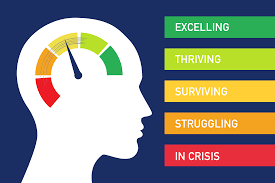
“So mental health is not a binary state – you are not either mentally healthy or ill. Our mental health falls on a continuum, ranging from excellent mental health to severe symptoms such as panic attacks or major depressive episodes”

Delphis.org.uk


Feeling a degree of stress at points within a term is normal and part of the profession, we all have pinch points through an academic year that can be pressured and stressful. We do need to remember that this is normal, as long as it remains manageable. However, we must be able to recognise if we begin to feel overwhelmed, overly stressed or anxious, which can then prevent us effectively fulfilling our role and responsibilities towards our families and students. This is where we begin transitioning from the thriving to the struggling zones on the continuum. Some of the characteristics of these zones are being distracted, withdrawn, losing our appetite, feeling nervous and sad, and having trouble sleeping. 

So what can we do if we feel we're descending to these zones? Well we must remember to prioritise our own self care, be honest with ourselves about things that aren’t absolutely necessary, and move them lower on our list to make room for some self-care to restore our wellbeing. What this self-care looks like for each of us is different - but finding time outside of work to do something you enjoy throughout the week is a great starting point, this could be exercise, reading a book or any other activity that can help us escape from built up anxieties. 


Talking to each other is another crucial self-care strategy. Talk about your issues and problems with your colleagues and those around you. Try using the ask twice approach - when we ask someone if they are OK the response is usually “yes- fine”... ask again! Asking twice allows that person to know you really do care and you do want to know the answer and are prepared to listen. 

If things are getting really tough ask for help - asking for help shouldn't be something to feel ashamed of, we all move up and down the mental health spectrum throughout our lives, there is absolutely no shame in reaching out and asking for help.  


For further information and reading try follwoing some of the links below:

Hannah Harwood - Assistant Headteacher

You can follow Hannah @hannahharwood4

Wednesday, 10 November 2021

Getting better quicker as an ECT - Charles Peprah

It is always a proud moment to have finally been told you have completed your Initial Teacher Training and to be awarded Qualified Teacher Status. However, this achievement can be accompanied by a thoughtful and sober reflection of the difficulties, challenges, and opportunities that presented themselves during the training year and thus reflect anxieties of the future. 

These anxieties can include: 

  • What is behaviour going to be like?
  • How is my planning going to change?
  • Will I be able to keep up with the work?
  • Is my subject knowledge up to standard?
  • Is my mentor going to be there for me?
  • Is the school going to support me?

In view of this, it is right that Early Career Teachers (ECTs) receive the right support and guidance to support their career development. Recently the DfE have introduced the Early Career Framework and ECT support programmes as a way of easing new teachers into the profession and helping them to get better quicker.

So how do you get better quicker?

It is the desire of every employee to get better at their work within the shortest possible time after they have been employed. Teaching is no different considering you are meeting the needs of over 100 young pupils a day and about 250 a week. You will meet pupils who are very resilient, independent, charismatic, enthusiastic, and those who hardly care to put pen to paper. There are no magic bullets as to how specific instructions and actions will make an ECTs better in the classroom in the shortest period of time, however I always encourage ECTs to consider the ideas below to get them started.

1. Make sure you understand the systems and processes of your school

Systems and processes vary from one school to another, so make sure during your induction and early days you read the policies of the school and understand how the school system works. For example, behaviour management and standards in and out of the classroom, marking and feedback, safeguarding and child protection and so on. The systems and processes are there to help members of staff to go about their duties in a consistent and accepted way. Remember, in teaching, consistency is one of the keys to unlocking your potential. You do not want a child or a parent to challenge you about what the school policy says about an action you have taken without having the right response to it!

2. Ask for and seek support

Experience is key in teaching. Most experienced teachers know what works and what does not work in their schools. Ensure that you make good use of your additional PPA time to seek advice from experienced teachers within and outside your department. Make time to observe good practice in areas that you struggle with, and do not shy away from asking questions that may seem ‘silly’ but will help improve on your pedagogy in the classroom. For example, how do you position yourself in the classroom to ensure that you have a 360 degree view of your classroom?

3. Use your ECT time effectively to develop your subject knowledge

It is always said that the teachers who are passionate, motivational, and can make pupils curious about their subjects, are those with deep subject knowledge. Yet, it is not always possible to remember everything about the subject that you are teaching, especially if you left university 10 years ago or are teaching a subject in your non-specialist area. However, making sure you have access to all the necessary textbooks and that you are engaging with them and understand them is a neccesity. Furthermore, registering with professional bodies and subject associations, who provide high quality CPD programmes is a great idea. they often are free or heavily discounted for ECTs.

4. Protect time to relax and switch off

There is an adage that says “ all work and no play makes jack a dull boy”.  Teaching is a high energy intensive job and will always require much from you, but you need to be able to organise your time in such a way that you have time to partake in other hobbies and activities that you enjoy. Most often the skills from those hobbies could be used to improve your teaching. Do not leave the school gate at the end of the day feeling dejected due to an incident that had happened, speak to a leader about it before you leave or stay positive and seek support to solve it the next working day.

5. The Three Pillars

Finally, as always do not forget the basic three ‘pillars’ that you learnt during your training year.

  • Plan: Make sure you have time to plan lessons with our associate friend 'The teachers’ standards' in mind.
  • Action: Make sure you deliver your lessons with a proper structure.
  • Evaluate: Make sure you evaluate your teaching at the end of your lesson and use any lessons learned to improve the planning of your next lesson.


Remember, at Denbigh, there is always a member of staff who is ready to support you.

Charles Peprah - Assistant Headteacher and Professional Tutor.

Monday, 4 October 2021

Assessment for Learning - Jess Pather

“In the context of curriculum freedoms and increasing autonomy for schools, it would make no sense to prescribe any one model for assessment. Curriculum and assessment are inextricably linked. Schools should be free to develop an approach to assessment which aligns with their curriculum and works for their pupils and staff” 

Commission on Assessment Without Levels, 2015.

…so to, teachers ‘should be free to develop an approach to assessment which aligns with their curriculum and works for their pupils’. The expectation is that assessment for learning is continuous; there is no defined or instructed time-frame. Assessment should form a dialogue between teacher and pupil with the aim to improve pupils’ understanding, learning and raise achievement. Assessment should be motivating and meaningful for both teacher and learner - teachers will glean information about pupil performance and use this to inform planning and progression for individuals and groups, whilst pupils will have an acute awareness of what they need to do to improve but more importantly, how to improve and understand the importance of that progression.

Marking everything that moves does not gurantee progress - in fact it is detrimental. Honorous marking burns out teachers and takes away time from more impactful activities such as planning great lessons and delivering them with energy!

Marking and feedback are key components of effective assessment but the quantity of marking should not be confused with the quality. Both the regularity and purpose of marking and feedback should be communicated to pupils so that they have an informed expectation of assessment. To be effective, feedback through marking should be about challenging tasks or goals rather than easy ones. Give feedback about what has been done well and about what can be done better and ensure that pupils have time to make improvements and corrections to their work.

Focus on the 3Ms of marking: 

  • Meaningful 
  • Manageable 
  • Motivating

Meaningful marking will vary by age group, subject and what works best for the pupil and teacher in relation to learning and progress. Manageable means that marking is proportionate and considers the frequency and complexity of written feedback, as well as the cost and time effectiveness of marking in relation to the overall workload of teachers. Motivating marking should help to motivate pupils’ to progress. This does not mean always writing in-depth comments, sometimes, short, challenging comments or verbal feedback can be more effective.

If the teacher is doing more work than their pupils are, this can become a disincentive for pupils to accept challenges and take responsibility for improving their work.

Meaningful, manageable, motivating – make it matter.

Jess Pather

Follow Jess on twitter @JPather74

Further Reading


Tuesday, 7 September 2021

The Denbigh Teaching & Learning Philosophy - Ian Stonnell

What is the purpose of teaching? When you ask this question you often get a whole range of responses - "To improve the life chances of students"... "To give students a passion for my subject"... "To prepare students for the challenges of an ever changing world". These answers are all worthy and noble. However, they overcomplicate what the core purpose of teaching is - the purpose that ultimately will achieve those aims. The purpose of teaching is to transfer knowledge.


To know more and remember more
At Denbigh we want students to know more and remember more. The transfer of knowledge to our students and their ability to recall and apply this knowledge is at the heart of our every aim at school. It sounds simple - in principle it is - however in practice we know it is complex.

This focus on knowledge and recall makes memory an important concept for all teachers to grasp. At Denbigh, we use the multi-store model of memory as a starting point to explore the concept of memory and how it works. It may be familiar to you if you have ever studied psychology!
The multi-store model of memory. Read more about it here.
The multi-store model of memory states a few important things for teachers to consider:
  1. For knowledge to enter the short-term memory (working memory) students must pay attention to it - easier said than done.
  2. We must be careful not to overload too much new knowledge at once as this can cause an overload of the short-term memory. On average our short-term memory can take 5-9 items of new information and keep it there for around 20 seconds. Too much new information will cause knowledge to be displaced and forgotten... forever.
  3. For that knowledge to remain in the short-term memory it needs to be repeated and practised (maintenance rehearsal), hopefully some form of understanding may take place. If no maintenance rehearsal takes place, the knowledge will decay and be forgotten again... forever.
  4. Maintenance rehearsal on its own does not guarantee that knowledge will transfer to the long-term memory. For knowledge to process from the short-term memory to the long-term memory, it needs to be repeated over time and linked to other knowledge that already exists in the long-term memory (this relates to the schema theory of memory that we will encounter at our next PDD day).
  5. Even if we are successful in transferring knowledge to the long-term memory without retrieval practise, students can experience retrieval failure - the inability to recall. This is different to forgetting; however it is just as disasterous in an exam setting. Therefore students need to practise the skill of remembering - we call this retrieval practise.
Our new Teaching and Learning Model - PEPPA
Please believe me when I say that, when designing this model, I did not start out with PEPPA and then force a model into it. I assure you it was the opposite. The new model came into existence with the sole purpose of supporting our core aim - creating students who know more and remember more with a grounding in the multi-store model of memory. The mnuenomic PEPPA was a happy little accident, as Bob Ross would say, that fell out of this thinking. So what does PEPPA stand for?
Planning
A starting point for all teachers is the planning phase. At a macro level the important considerations are what knowledge we want to transfer and in what order we want to transfer it in (this is also known as the curriculum). At a micro level we are also talking about the planning of individual lessons - in what order do we sequence knowledge delivery, rehearsal and retrieval activities to maximise knowledge acquirement and recall.  

Engagement
Now if we have the planning secure we need to move on to the delivery and the most important part of delivery is engaging the students. If they are not engaged, they will not pay attention and we have already lost as there will be nothing in their short-term working memory. How do we engage? Well there are considerations we make in planning - well laid out resources, clear sequencing, clear explanations, setting the right level of challenge. There are also simple human factors to consider; do we have positive relationships with our students? Do we know our students' names, understand their individual needs, include everyone, and smile at them? Together, it is these considerations that make lessons engaging (not necessarilly 'fun'). 

Pedagogy
If the conditions are set through good planning and high engagement, it is now all about the knowledge transfer, practise and retrieval - this is live classroom pedagogy. This can vary from subject to subject and teacher to teacher; no lesson should look the same.  The list of pedagogical strategies to be used is endless, from: reading, teacher modelling and explanations, debates and discussions, quizzes, group work, essay writing and so on. The most important thing however, is their effectiveness in knowledge transfer, practise and retrieval. 

Progress
And the effectiveness can be measured through the progress students make - do they know it, do they remember it? As a class teacher, progress can be measured through assessment and feedback, formative and summative. Progress over time can also be seen by looking at books, Google classrooms and (the best way) by talking to students about their learning. 

Achievement
Now achievement is the outcome. If we apply this model succesfully, our students will know more and remember more and this is what will help improve their life chances and prepare them for the challenges of an ever changing world or whatever other moral or social aim of teaching you would like to instill. 

The Big Picture
New models should never sit on their own and look pretty. They must have a purpose. This model has a clear purpose in drawing teachers' focus to helping our students to know more and remember more by considering how memory works and focussing our thinking on sound evidence informed pedagogy. In addition, this model is integral to the wider teaching and learning ecosystem informing our approach to learning, quality assurance, appraisal and continuing professional development.
An example of a way this will be happening at Denbigh is through our instructional coaching programme. Using aspects of the Teaching Walkthrus handbook, teachers are able to access guides to refresh and reinvigorate their pedagogical practices as well as work with coaches over a sustained period of time to implement new strategies to drive improvement according to our new model.


I hope you all have a great start to the new term. Feel free to get in touch if you have any questions and rememebr to follow this blog or my twitter for updates of further teaching and learning news at Denbigh. 

Ian Stonnell @DenbighCPD
 

Wednesday, 3 March 2021

Thoughts on our return to school - Ian Stonnell

Out of the ashes the phoenix rises.
On Monday we meet our students in the classroom for the first time since December. That's quite a long time ago. Now, it will be easy for us to focus on the negatives when they return. We could conduct an audit of who completed their remote learning and who did not, we could give daunting lectures about the lost learning that has taken place and how we need to catch up as quickly as possible. We could dwell on the doom and gloom and have a wonderfully gloomy time doing it. 

This is not what we should do. 

Instead, we need to resist this understandable desire and remember that the times we are living through are extraordinary. No one can be blamed for the disruption that has taken place, particularly the students, and although some of them may have been lazy, the fact that they were given the opporuntiy to be so, by a global pandemic, is not really their fault - just think how you would have responded to a lockdown when you were thirteen! I know I would have struggled, and that would have been in a world with only 5 TV channels and dial up internet. We also cannot discount the reality that many of our students have had a terrible time during this lockdown and have genuine reasons for struggling to engage.

We must show understanding and forgiveness. 

On March 8th we are starting anew together, what has happened has happened and although it has been tough, we will recover and like a phoenix from the ashes, we will come back stronger.
Use the right language

To start anew we have we have to use the right language. At the moment there is a lot of concerning phrases being bandied about by politicians and 'tsars' with regards to education and, as was so neatly summed up by our inspirational headteacher Donna Neely-Hayes, a lot of this waffle needs to be ignored and filtered out - “our students are not damaged”. 

Instead we should see that our students have been through an experience that will define their childhood and scorch an indelible mark on their identity, where they can rightly be proud of their resilience, discipline and independence. I would argue that these students are not damaged, they have been tempered and made stronger whether they realise this yet or not. Let's reinforce that message by making sure we use the right language on their return and not perpetuate a story of loss that can only serve to damage their well-being, rather lets tell a story of growth.

Below is a table of some of the not so useful language that has been floating around with an equivalent positive language replacement which you can use in your classrooms, note how it encourages growth - credit to @MrAWGordon
Move forward with great teaching

Finally some thoughts on teaching, this is a teaching and learning blog after all. My key message - let's not panic, we have done this before. When we returned in September after the first lockdown, we managed just fine. In fact I seem to remember all of us getting so much better at using technology for learning - it was inspirational. I also know that each department has already spent a lot of time planning for the return particularly with a focus on the curriculum, so we are ready. 

However, as a guide, for those first few lessons on our return the following basics can be adhered to:
  1. Retreive: Start of with a stimulus of what may have been covered over lockdown then assess with some low stakes retrieval and questioing to identify gaps in knowledge on small, key parts of the curriculum.
  2. Re-teach: Once gaps are identified, using direct instruction re-teach topics with an emphasis on the gaps - providing models and scaffolding where necessary.
Regardless of this, for now you should have faith in your ability to be what you already are - amazing teachers. No doubt in the near future we will be doing lots more to improve and get even better at supporting our students, that's just what we do. However, that is for the future, on Monday let's just get back to it.

Ian Stonnell @DenbighCPD

Wednesday, 24 February 2021

Blended Learning - 3 Smart ways to use Google Rubrics - Ian Stonnell

A few months ago I wrote a post about the rubric function in Google Assignments and how you can create them. If you are still unfamiliar with what a rubric is you can read that post (and watch the some exemplar videos) here. 

I am pleased to say that since that post was published staff at Denbigh have gone on to create many rubrics to help assess the progress of students and give feedback. These rubrics have had the added benefit of reducing workload in the marking process. 

In this blog we will look at three effective ways that rubrics have been used across the school. If you have any other unique ways you are using rubrics please get in touch to let me know.

1) The rubric that 'soft marks'
I'll be honest, this is essentially the 'tick and flick' equivalent of marking on Google Classroom (yet slightly better as I'll explain).  At it's heart it is a simple rubric that does the equivalent of RAGing a piece of work and has been applied by many departments. Take a look at this example below that assesses 'quality of work' it is so generic it could be applied to almost any subject.

Click the image to see a Google Sheet of this rubric (CLT staff only)
The advantage of a this rubric is that it is quick to set up and generates simple numeric data that is automatically stored in the markbook for every online lesson or homework task that a student completes. The rubric also helps teachers roughly assess, or 'soft mark', work that may not necessarily have a numeric value or be a key point of assessment that requires detailed marking. This type of marking also gives teachers a general understanding of student engagement and attitudes and can keep students motivated and on their toes. The disadvantage is that the feedback this rubric generates to students is not overly helpful in supporting progress, it just lets them know how happy you are with their work.
On a side note here is a great blog in defence of 'tick and flick' by David Didau.
2) The rubric that mimics assessment criteria
These rubrics are far more complex as they attempt to reflect the assessment or marking criteria of a particular exam question or a set of KPIs for a particular subject. They may also only apply to a specific task/exam question in a subject area. Take a look at this example from English which provides a rubric for their 24 mark question in the GCSE language paper - it looks like a lot of work went into it!

Click the image to see a Google Sheet of this rubric (CLT staff only)
However, despite the initial effort that is required to create a rubric like this the reward is great. First of all, the time it takes to mark an essay is reduced to a few clicks which automatically generates a score. Secondly, the rubric creates a highly valid bank of data that smartly identifies weaknesses which can in turn help formulate valid targets for a student and also help inform future teaching. The only drawback to this kind of rubric is the danger that a student may not be able to access the language of complex mark scheme or exam criteria if the rubric reflects it too closely. As such when they receive a mark and look at a rubric it may be difficult for students to decipher what it means and therefore not benefit from it. This highlights the importance of either thinking about the language we use when we create this kind of rubric or spending lesson time to help students understand the that criteria - something that is not always necessary or useful.

3) The rubric that provides scaffolding and develops metacognition
The weakness of the previous rubric leads on to this final rubric possibility; a rubric that is designed to scaffold a task and develop metacognition. With this kind of rubric there may be a complete abandonment of any complex and convoluted language related to exam criteria and in its place a pupil friendly instructional language which guides students to succeed in a task process or skill. 

In History and RE they have been developing rubrics just like this to help students answer longer essay questions and, rather than using the examination marking criteria, they have produced instructional rubrics that provide the scaffolds for different stages of the writing process. Take this example below where the rubric follows a paragraph by paragraph approach detailing what is expected from each stage which ultimately build towards a more complete answer.

Click the image to see a Google Sheet of this rubric (CLT staff only)
The advantage of this rubric is that it helps students develop metacognition skills for a specific task (the process of writing this essay becomes ingrained the more they engage with the rubric) and although it may not neatly match up with an examination marking criteria, by students following the process they will develop consistency and competency in the task to the point that the rubric will barely be needed - as will happen in an exam. Of course personalized feedback can still be created to support progress further (as with any rubric) however, in this example it is the rubric that will underpin the skill.

A well thought out rubric can support progress and build confidence.
I hope you have found this blog useful. If you want further support developing rubrics please have a discussion with your team leader or let me know and I'll be happy to help. Thanks to all the teachers who have contributed to this blog and keep up the great work! 

Ian Stonnell @DenbighCPD

Tuesday, 2 February 2021

Remote Learning - How to encourage peer interaction in Google Classroom - Ian Stonnell

At Denbigh we do not do 'live' lessons in the way they are portrayed in the media. Rather we take a synchronous approach were we post resources on Google Classroom, including pre-records, set tasks and then watch the work come in to give feedback on. During this time we are available to answer questions submitted via email or through the Classroom comments section. This approach has the advantage of allowing students to get the work done at their own pace and even go asynchronous if needed.

However, the issue with this approach can be the lack of peer interaction. This is quite a concern as the EEF found that during remote learning periods, peer interactions helped to improve motivation and led to better outcomes. This probably makes a lot of sense after all for many subjects peer interaction, though debate and discussion, is often the lifeblood of a lesson that characterizes deep learning and understanding. 

The loss of peer interaction is inherently de-motivating and can limit pupil progress.

The question is how can we bring back some of this peer interaction into our current model of remote learning? In this blog we will look at a few ways that teachers have been attempting to do this using Google Classroom. If you have any other ideas please get in touch and let me know! 

1. Using the 'Announcement' feature to encourage discussion in History
In this example Sana Tariq encouraged peer interaction by using an announcement to pose an open question assessing prior knowledge about the Crusades. Students responded rapidly through the lesson hour. During this time Sana responded to comments, checked misconceptions, issued praise and asked further developmental questions which encouraged students to conduct their own research on the topic. 

In total 41 comments were made and students certainly got a good feel for other students being present in the classroom working toward the same learning goals.

2. Using the 'Question' feature to encourage debate in RE
When setting assignments Google Classroom offers a 'question' feature. It is a wonderful way to encourage general discussion and debate in an online setting.

An example of how to set up a debate question on Google Classroom.

When you set a question it creates what is essentially a message board, where students can answer the question and also reply to other student's answers. It also places the teacher as a moderator who can equally engage with discussion, adding comments, responding to comment and adding further questions and so on, as well as have the ability to delete comments and mute students if needed (this feature is available throughout the Google Classroom - just click on the 3 dots next to any comment). 

Last week the whole RE department used this approach in a year 7 debate about the nature of evil and suffering. This generated some passionate arguments and top quality work, largely due to the genuine peer interaction that was offered. 


3. Sharing documents to enable peer marking in English 
Finally, in English they have been using peer marking as a way of encouraging student interaction. Using the sharing settings on any document, a student can give access rights to one of their peers allowing them to make comments and suggestions which can be reviewed by the class teacher.

An example of peer marking in year 11 English.

Considering the benefits of encouraging peer interaction I hope you give one of these strategies a go. You could possibly do it as a review activity for the learning students have engaged in so far, I know that's what I am going to. 

Thanks to all the teachers who have contributed to this week's blog! 

Ian Stonnell @DenbighCPD